Key Takeaways
- 01RAG Chatbots connect AI with trusted business data to deliver accurate and relevant responses.
- 02Retrieval augmented generation helps businesses provide context-based answers using their existing information.
- 03AI knowledge bases make business information easier to access through natural language conversations.
- 04RAG Chatbots can support customer service, employees, sales, HR, and technical teams.
- 05eBotify helps businesses build smarter chatbot experiences using business specific knowledge and conversational AI.
Traditional chatbots often struggle to provide accurate, business-specific answers because they rely on limited, predefined information. A RAG Chatbot solves this challenge by connecting conversational AI with relevant business data. This allows businesses to deliver more useful responses based on trusted information instead of relying only on static responses.
Retrieval augmented generation helps businesses make AI conversations more relevant, reliable, and context aware. By connecting AI with an AI knowledge base, businesses can provide customers and employees with timely information across different use cases. As organizations seek smarter enterprise chatbot solutions, RAG is becoming increasingly valuable. In this blog, we explore how RAG Chatbots work, their business benefits, key use cases, and why they are becoming essential for modern organizations.
What is a RAG Chatbot?
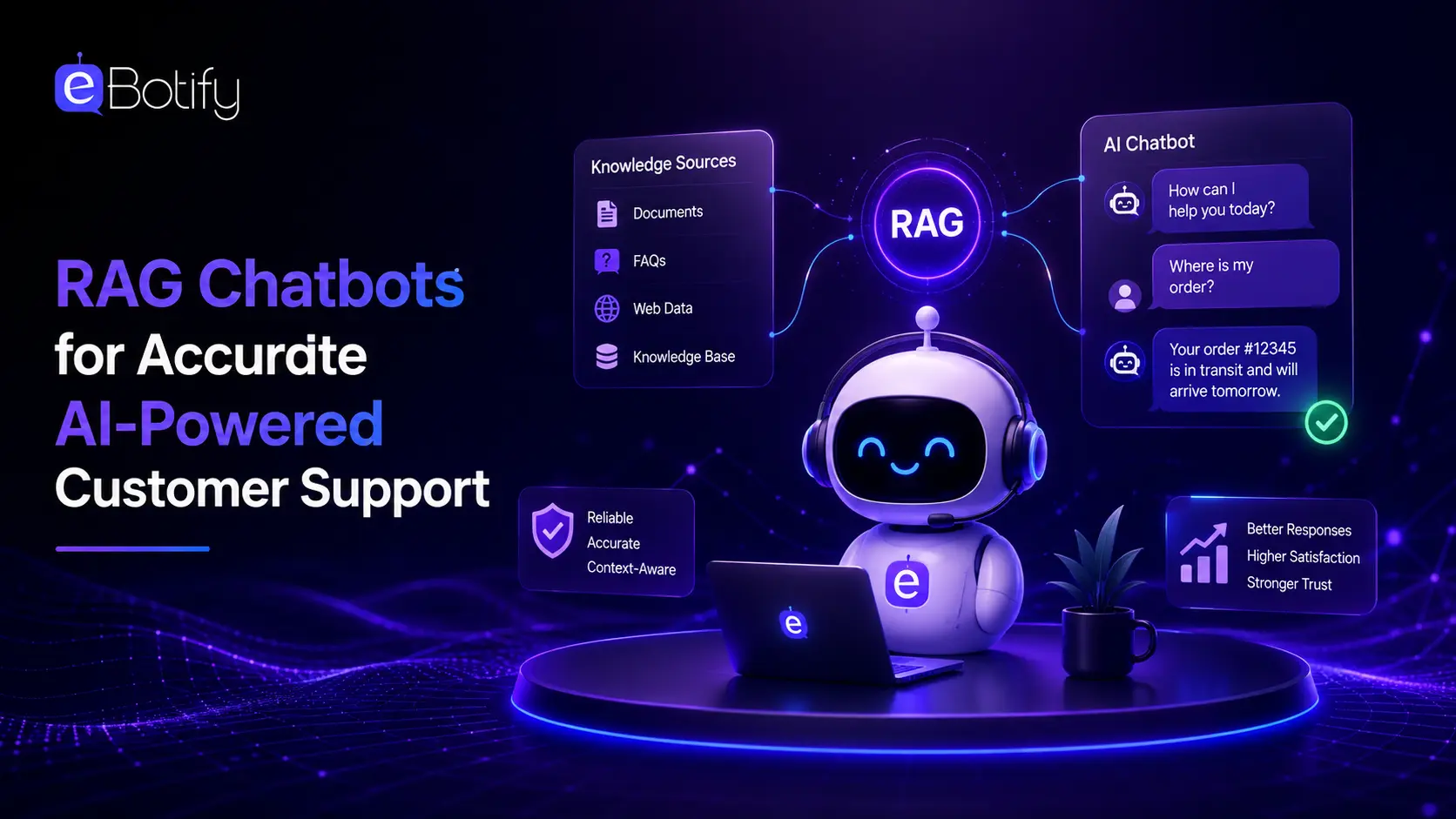
A RAG Chatbot combines conversational AI with retrieval augmented generation to deliver accurate and relevant responses. Instead of depending only on information learned during model training, it retrieves relevant information from trusted business sources before generating an answer. This approach helps businesses create chatbot experiences that understand context and provide more useful information.
The chatbot first searches connected sources such as documents, FAQs, knowledge bases, product information, or internal records. It then provides the relevant information to the AI model as context. The model uses this context to generate a response that better matches the user’s question and the organization’s available information.
How is a RAG Chatbot Different From a Traditional Chatbot?
Traditional chatbots typically depend on predefined rules, fixed responses, or limited training data. This can make them less effective when users ask complex questions or need information that changes frequently. A RAG Chatbot can retrieve updated information from connected sources, making its responses more flexible and relevant.
This capability makes RAG Chatbots particularly useful for businesses managing large amounts of information. They can connect conversational AI with an organization’s AI knowledge base, helping users access relevant information through natural conversations.
| Feature | Traditional Chatbot | RAG Chatbot |
| Knowledge Source | Uses predefined responses or trained data | Retrieves information from connected business sources |
| Response Accuracy | May provide limited or generic answers | Provides more relevant, context-based answers |
| Business Data | Limited access to internal information | Can connect with documents, databases, FAQs, and knowledge bases |
| Information Updates | Often requires manual updates or retraining | Can retrieve updated information from connected sources |
| User Queries | Best suited for simple and predictable questions | Handles complex and business specific questions |
| Scalability | Can become difficult to maintain as information grows | Can scale with expanding business knowledge |
| Use Cases | Basic FAQs and simple customer support | Customer service, employee support, sales, documentation, and enterprise use cases |
How Does a RAG Chatbot Work?
A RAG Chatbot follows a structured process to find relevant information and generate useful responses. It connects business data with AI, allowing users to receive answers based on trusted and relevant sources.
1. Connect Business Data
The chatbot connects with documents, FAQs, databases, websites, and other business information. These sources provide the knowledge required to answer user questions accurately.
2. Retrieve Relevant Information
When a user asks a question, the system searches connected data for relevant information. It identifies the content that best matches the user’s query and context.
3. Provide Context to the AI Model
The retrieved information is passed to the AI model as an additional context. This helps the model understand the question and generate a response based on relevant business knowledge.
4. Generate an Accurate Response
The AI model processes the user’s question along with the retrieved information. It then creates a clear and relevant response using the available context.
5. Deliver the Answer
The chatbot presents the generated response directly to the user through the chosen conversational platform. This creates a faster and more natural way to access business information.
Why Do Businesses Need RAG Chatbots?
Businesses handle large amounts of information across documents, systems, and customer interactions. RAG Chatbots help make this information easier to access while delivering more relevant and useful conversations.
1. More Accurate and Relevant Responses
RAG Chatbots retrieve information from trusted business sources before generating responses. This helps reduce generic answers and improves response relevance.
2. Access to Business Specific Knowledge
Businesses can connect chatbots with their own documents, policies, FAQs, and databases. This allows users to receive answers based on company specific information.
3. Faster Access to Information
Employees and customers can find relevant information through simple conversations. This reduces the time spent searching through multiple documents or systems.
4. Reduced Support Workload
RAG Chatbots can handle common questions without requiring constant human assistance. Support teams can then focus on complex issues that need personal attention.
5. Better Customer and Employee Experiences
Users receive quick responses based on relevant business information. This creates a smoother experience while improving access to organizational knowledge, paving the way for more advanced solutions like emotionally intelligent chatbots.
Key Business Use Cases for RAG Chatbots
RAG Chatbots can support different business functions by connecting conversations with relevant organizational information. Their ability to access an AI knowledge base makes them useful across customer service, sales, HR, and internal operations.
1. Customer Support and FAQs
An enterprise chatbot can answer common customer questions using approved business information. This helps support teams provide faster and more consistent responses, highlighting the importance of chatbots for websites.
2. Internal Employee Assistance
Employees can use a chatbot to quickly find company policies, procedures, and internal documents. This reduces time spent searching through multiple knowledge sources.
3. Product and Service Information
Businesses can connect product catalogs, service details, and documentation with conversational AI. Customers can then receive relevant information without navigating multiple pages.
4. Sales and Lead Qualification
A knowledge driven chatbot can answer product questions and collect information from potential customers. It can also support sales teams by providing relevant information during early conversations.
5. HR and Company Policy Support
Employees can ask questions about workplace policies, benefits, procedures, and other HR information. The chatbot retrieves relevant details from approved internal resources.
6. Technical and Documentation Assistance
Teams can use a RAG powered chatbot to search technical documents, guides, and product resources. This provides faster access to information needed for troubleshooting and daily tasks, and can even extend to integrating chatbots with digital twins for real-time operational support.
How RAG Chatbots Strengthen Business Knowledge?
Retrieval Augmented Generation Chatbots make business information easier to access. They turn scattered data into useful AI-powered knowledge.
1. Centralize Business Information
Connect documents, databases, and internal resources in one knowledge system. This makes business information easier to access.
2. Keep Knowledge Contextual
The system retrieves information based on each question. This keeps responses focused and relevant.
3. Support Knowledge Sharing
Employees can quickly find information without asking other teams. This improves knowledge sharing across the organization.
4. Improve Information Discovery
Users can ask questions in natural language. The chatbot finds relevant information from connected sources.
5. Build a Strong AI Foundation
A reliable knowledge base strengthens AI applications. It also supports future automation and smarter workflows.
Ready to Make Your Business Conversations Smarter?
RAG Chatbots help businesses deliver faster and more relevant answers. They connect AI with trusted business knowledge for better conversations. With retrieval augmented generation, organizations can improve support, simplify information access, and create smarter digital experiences. This makes RAG a practical choice for businesses building reliable AI solutions.
eBotify helps businesses build intelligent chatbot solutions powered by business specific knowledge. Its solutions can connect your data with conversational AI to deliver useful customer and employee experiences. With eBotify, businesses can turn their existing knowledge into smarter conversations and create scalable chatbot experiences for changing business needs. To stay updated on industry trends, explore our latest insights on AI chatbots and conversational AI.
Frequently Asked Questions
1. How does a RAG Chatbot improve customer interactions?
A RAG Chatbot provides relevant answers using trusted business information, helping customers resolve questions faster without relying heavily on support teams.
2. Can RAG Chatbots work with existing business documents?
Yes, RAG Chatbots can connect with documents, FAQs, databases, policies, and other trusted sources to provide useful business specific information.
3. Is a RAG Chatbot useful for internal teams?
Yes, employees can quickly find company information, policies, technical documents, and procedures without searching across multiple platforms.
4. How can businesses keep chatbot information relevant?
Connecting the chatbot with updated business sources helps it retrieve current information and provide responses that better reflect organizational knowledge.
5. Which businesses can benefit from RAG Chatbots?
Businesses across customer service, sales, healthcare, finance, technology, and other sectors can use RAG Chatbots for knowledge-driven conversations.