Key Takeaways
- 01
Model Context Protocol simplifies how AI chatbots connect with business tools and external data. - 02
MCP reduces integration complexity by providing a standardized communication framework for AI applications. - 03
Businesses can use MCP to connect chatbots with CRM, project management, and support systems. - 04
MCP enables AI chatbots to perform tasks instead of only providing information or answering questions. - 05
Strong security, permissions, and governance are essential when connecting AI with enterprise systems.
Traditional chatbot integrations often struggle as businesses add more tools, platforms, and data sources. Model Context Protocol offers a standardized way for AI systems to connect with external tools and business data, reducing integration complexity while helping chatbots access relevant information and perform useful actions.
As businesses seek smarter AI integrations, MCP creates a more connected approach to enterprise automation. It helps AI chatbots interact with business systems through a consistent framework. In this blog, we explore how MCP is transforming business integrations and enabling more capable AI chatbots.
What is Model Context Protocol?
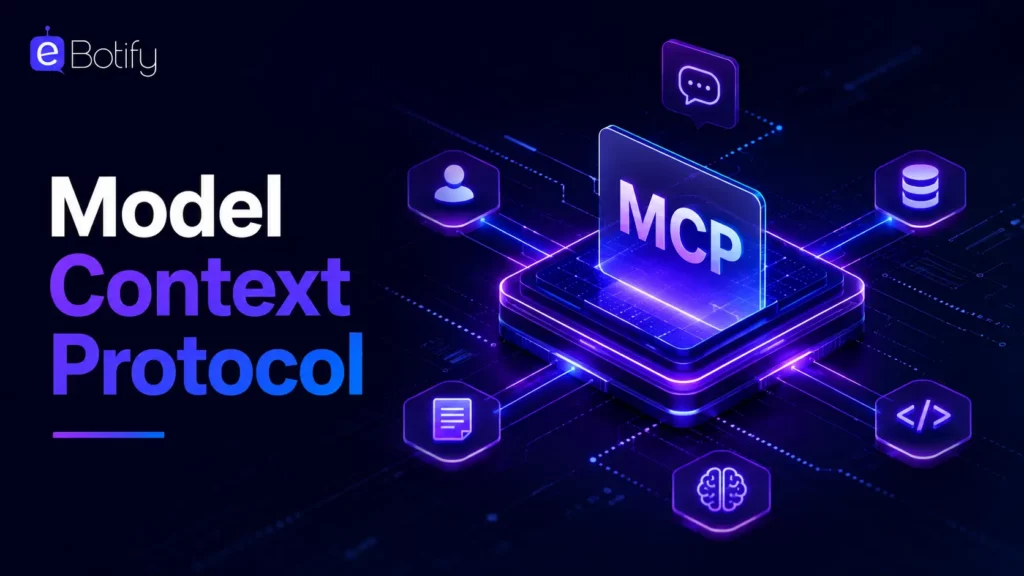
Model Context Protocol (MCP) is an open standard that helps AI applications connect with external tools, data sources, and business systems. It provides a consistent way for AI models to access relevant information and use available capabilities without requiring separate, custom integrations for every application or data source.
Unlike traditional API-based integrations, MCP provides a common communication framework between AI applications and connected tools. This makes integrations easier to reuse, manage, and expand as business needs grow. As an **AI protocol**, MCP can simplify how chatbots and AI agents interact with different systems.
How MCP Works with AI Chatbots?
MCP creates a structured connection between an AI chatbot and the tools or data it needs to complete a task. Instead of building a separate integration for every system, the chatbot can communicate through a standardized framework. This allows AI applications to discover available tools, understand their functions, and use them when required.
The process typically involves three key components:
1. MCP Client
Connects the AI application to MCP servers and manages communication.
2. MCP Server
Provides access to specific tools, data, or business capabilities.
3. AI Model
Understands the user’s request and determines which available resources can help complete it.
For example, when a user asks a chatbot about a project status, the AI can access connected project management data through an MCP server. It can retrieve relevant information, process the context, and provide a useful response without requiring the user to switch between different applications.
This approach makes AI chatbots more flexible because businesses can connect multiple tools through a consistent communication layer. As organizations add new systems, they can extend the chatbot’s capabilities without redesigning the entire integration architecture.
Why Businesses Need MCP for AI Integrations?
As businesses adopt more AI applications, connecting them with multiple systems can become complex and difficult to manage. MCP provides a standardized approach that helps organizations build connected AI experiences with less integration overhead.
1. Reduce Integration Complexity
MCP creates a consistent connection between AI applications and business tools. This reduces the need for separate integration methods across different systems.
2. Connect Multiple Applications
Businesses can connect AI chatbots with CRM, ERP, project management, and other platforms. This allows AI to access relevant information across different business environments.
3. Improve Chatbot Capabilities
Connected chatbots can retrieve information and interact with business tools when needed. This makes conversation more useful and action oriented.
4. Simplify Scalability
Organizations can add new tools without rebuilding their entire AI integration architecture. MCP supports a more flexible approach as business requirements evolve.
5. Support Business Automation
MCP enables AI applications to interact with tools that support everyday workflows. This creates opportunities to automate repetitive tasks and reduce manual effort.
Key Business Use Cases for MCP Powered Chatbots
MCP can help businesses connect AI chatbots with the systems employees already use every day. This enables chatbots to access information and support actions across different business workflows.
1. CRM Integration
Chatbots can retrieve customer details and relevant sales information. They can also support updates within connected CRM systems.
2. Project Management
AI chatbots can access project tasks, deadlines, and status updates. Teams can get important project information through simple conversations.
4. Business Intelligence
Chatbots can connect with business data and reporting systems. Users can ask questions and receive insights without manually searching dashboards.
5. Customer Support
MCP can connect chatbots with knowledge bases and support platforms. This helps agents access relevant information and respond to customer requests faster.
6. Enterprise Workflows
AI chatbots can interact with multiple business tools through connected MCP servers. This can help automate repetitive tasks and streamline everyday operations.
MCP vs Traditional AI Integrations: A Difference Table
Traditional integrations often require separate connections between AI applications and individual business systems. MCP provides a standardized approach that can make these connections easier to manage and scale.
| Factor | MCP Based Integration | Traditional API Integration |
| Integration Approach | Uses a standardized framework for connecting AI with tools and data | Requires individual integrations for different systems |
| Scalability | Easier to extend across multiple tools and applications | Scaling can require additional development work |
| Reusability | MCP servers and tools can support multiple AI applications | Integrations are often built for specific applications |
| Maintenance | Centralized approach can simplify integration management | Multiple custom connections can increase maintenance needs |
| Tool Discovery | AI applications can discover available tools and capabilities | Tools usually need to be explicitly configured |
| Context Sharing | Designed to provide relevant context between AI and connected resources | Context handling depends on the individual integration |
| Flexibility | Supports a broader range of AI powered workflows | Flexibility depends on each API and integration setup |
Security and Governance Considerations for MCP
Connecting AI with business systems also introduces important security and governance requirements. Businesses should establish clear controls before allowing AI applications to access sensitive data or perform actions.
1. Authentication and Authorization
Verify every application and user accessing connected systems. Apply role-based permissions to control available tools and data.
2. Data Privacy
Protect sensitive business and customer information during AI interactions. Follow relevant privacy requirements and organizational data policies.
3. Permission Based Actions
Limit AI access to actions that are necessary for specific tasks. High impact actions should require additional approval where appropriate.
4. Monitoring and Auditing
Track AI interactions with connected tools and business systems. Regular monitoring can help identify unusual activity and support accountability.
5. Enterprise Governance
Define clear policies for MCP servers, connected tools, and data access. Strong governance helps organizations adopt MCP while maintaining security and operational control.
How MCP Enables Business Automation?
MCP helps AI chatbots interact with business tools and complete tasks. This makes automation more practical across everyday workflows.
1. Move From Answers to Actions
AI can perform tasks using connected tools. Chatbots become more action oriented.
2. Connect Business Workflows
MCP connects chatbots with business systems. This helps streamline connected workflows.
3. Automate Repetitive Processes
AI can handle routine tasks automatically. This reduces manual work for teams.
4. Build Intelligent Assistants
Assistants can access business data when needed. This helps employees work faster.
5. Support Agentic AI
MCP gives AI agents access to tools. This supports smarter and more autonomous workflows.
Ready to Make Your AI Chatbot More Connected?
MCP is changing how businesses connect AI chatbots with tools, data, and workflows. Its standardized approach can simplify integrations, support automation, and help AI applications take meaningful actions. As enterprise AI adoption grows, MCP can help businesses build more flexible, scalable, and connected chatbot experiences.
eBotify helps businesses build intelligent chatbot solutions that connect conversations with business processes. With AI powered automation and seamless integrations, eBotify can help organizations improve customer engagement and streamline operations. Explore how eBotify can support your next AI chatbot initiative.
Frequently Asked Questions
1. What is Model Context Protocol used for in business?
Model Context Protocol helps AI applications connect with business tools, data sources, and workflows through a standardized communication framework.
2. Can MCP help businesses automate chatbot workflows?
Yes, MCP can help chatbots access connected tools, retrieve information, update records, and support repetitive business processes more efficiently.
3. How does MCP differ from traditional API integrations?
Traditional APIs often require separate integrations for individual systems, while MCP provides a consistent framework for connecting AI applications with multiple tools.
4. Is MCP suitable for enterprise AI chatbots?
MCP can support enterprise chatbots by connecting them with business systems while providing a structured approach to tool access, permissions, and data management.
5. What should businesses consider before adopting MCP?
Businesses should evaluate security, access permissions, data privacy, existing systems, governance requirements, and the workflows they want AI to support.