Key Takeaways
- 01
AI chatbots handle conversations, while AI agents can execute multi-step tasks with limited human intervention. - 02
Rule-based and AI-powered chatbots help automate customer support, lead generation, and routine queries. - 03
AI agents use reasoning, memory, and connected tools to complete complex business workflows. - 04
AI automation can reduce manual work and improve efficiency across customer service and operations. - 05
Choosing between AI agents and AI chatbots depends on business goals, task complexity, and integration needs.
An AI chatbot can answer a customer’s question in seconds, but what happens when the task requires checking records, updating systems, and completing several steps without constant human input? The difference between AI agents vs AI chatbots lies in how they handle such responsibilities. Choosing the right technology can shape your customer experience, operational efficiency, and automation strategy.
Both technologies can improve how businesses interact with customers and manage everyday tasks, but their capabilities serve different needs. The real challenge is knowing where conversation ends and intelligent action begins. In this blog, we compare their capabilities, key differences, use cases, and costs to help you choose the right approach for your business.
What Is an AI Chatbot?
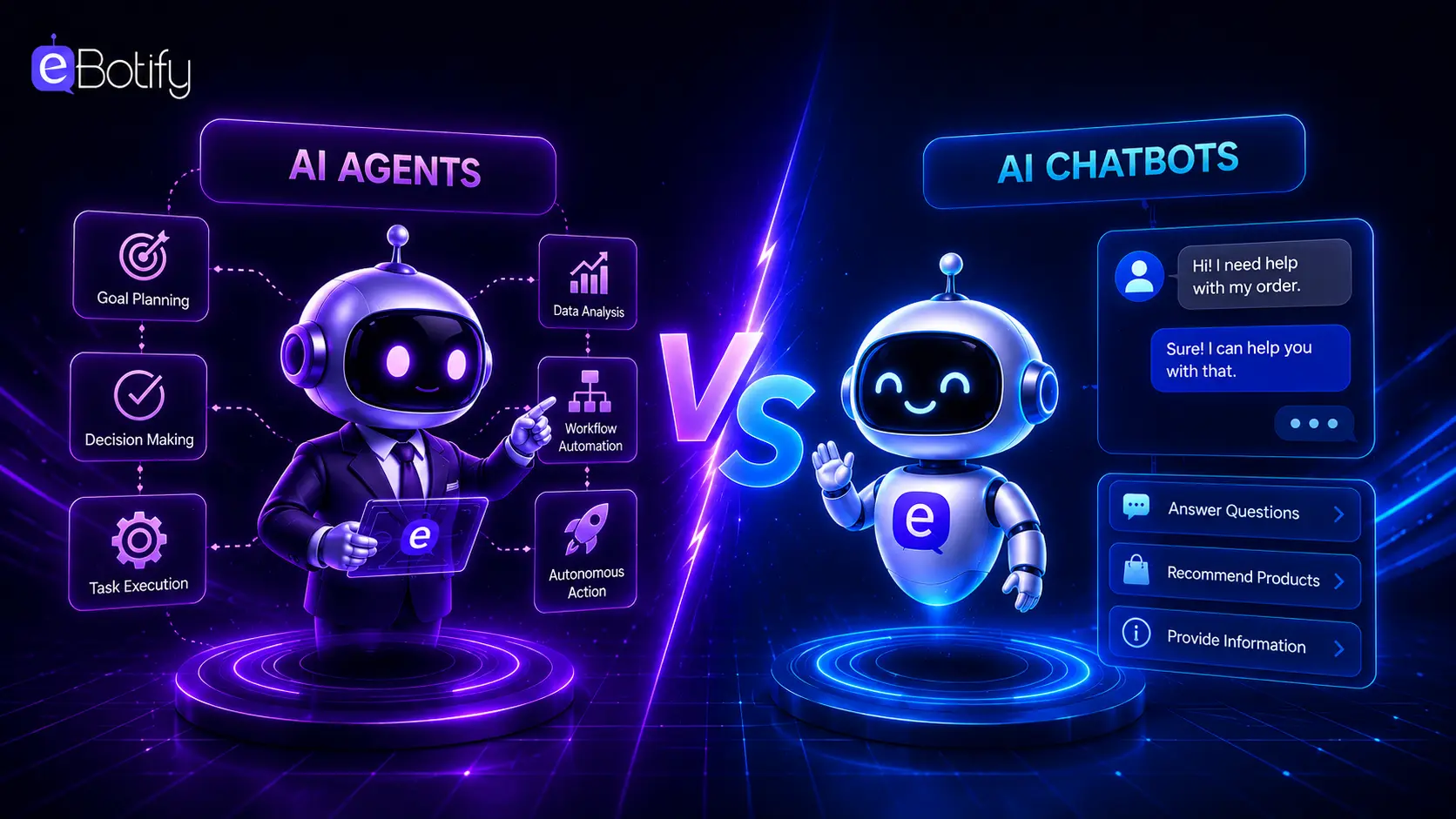
An AI chatbot is a software application that communicates with users through text or voice, understands their questions, and provides relevant responses. It uses conversational AI to handle customer queries, share information, and support routine tasks without requiring a human agent for every interaction.
AI chatbots generally fall into two categories:
- Rule-based chatbots: Follow predefined rules, menus, and decision paths to answer specific questions.
- AI-powered chatbots: Use natural language processing and large language models (LLMs) to understand user intent and generate more flexible, context-aware responses.
Businesses commonly use AI chatbots for customer support, lead qualification, product recommendations, appointment scheduling, and order status updates. For example, an online store can use a chatbot to answer questions about product availability, explain return policies, and help customers find suitable products.
Their main strength is making conversations faster and more accessible. However, when a task involves multiple systems, complex decisions, or several actions that must be completed in sequence, a chatbot may require additional integrations or human assistance.
Benefits of AI Chatbots include:
- Faster customer support: Answer common questions instantly and reduce waiting times.
- 24/7 availability: Assist customers outside regular business hours.
- Lower support workload: Handle repetitive queries so employees can focus on complex issues.
- Consistent communication: Deliver accurate, standardized responses to frequently asked questions.
- Lead generation: Collect visitor details, qualify prospects, and guide them toward relevant products or services.
What Is an AI Agent?
An AI agent is a software system that can understand a goal, make decisions, and take actions to achieve it. Unlike a traditional chatbot that mainly responds to questions, an AI agent can break a task into smaller steps, use connected tools, and work through a process with limited human intervention.
AI agents typically combine large language models (LLMs), memory, reasoning capabilities, and integrations with external tools such as APIs, databases, and business applications. These components help them gather information, decide what to do next, and adjust their actions when circumstances change.
For example, an AI agent handling a customer order could check inventory, verify payment status, update order records, and notify the customer. This ability to manage connected tasks makes AI agents useful for business process automation, research, reporting, and complex customer service workflows.
Benefits of AI Agents include:
- End-to-end task execution: Complete multi-step workflows with limited human intervention.
- Reduced manual work: Automate repetitive processes across connected business applications.
- Smarter decision-making: Use available information and defined goals to determine the next action.
- Cross-system coordination: Retrieve data, update records, and trigger actions across different tools.
- Adaptable workflows: Adjust their approach when tasks require additional information or alternative steps.
- Improved operational efficiency: Help teams manage complex, time-consuming processes at scale.
AI Agents vs AI Chatbots: Key Differences
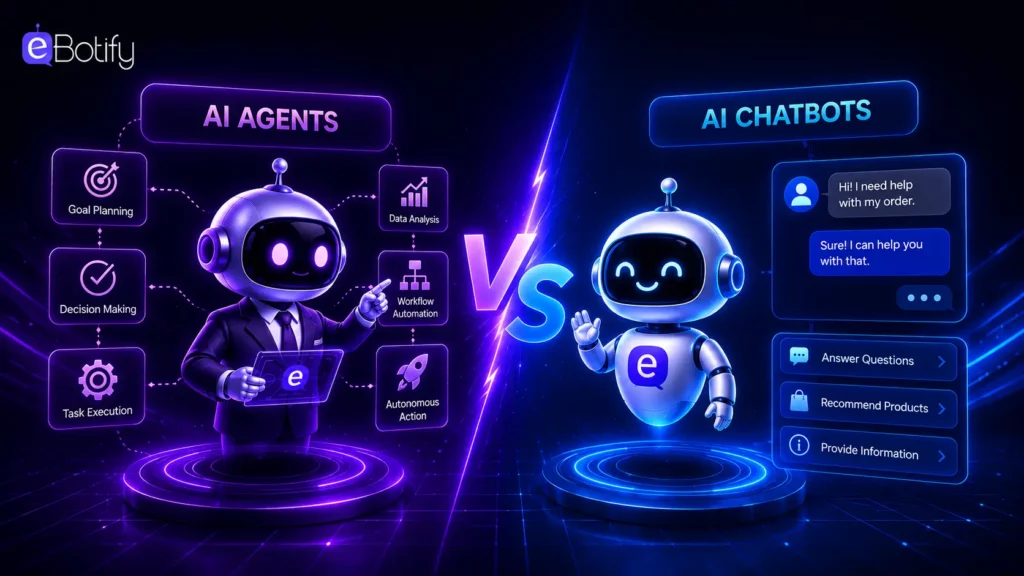
The main difference between AI agents and AI chatbots is how they handle tasks. Chatbots primarily focus on conversations, while AI agents can use tools, make decisions, and execute multi-step workflows. Here are the key differences businesses should understand.
| Comparison factor | AI Chatbots | AI Agents |
| Primary purpose | Answer questions and assist users | Achieve goals by completing tasks |
| Autonomy | Usually respond to user requests | Can plan and execute multiple steps |
| Task complexity | Best for defined, routine interactions | Suitable for complex, multi-step workflows |
| Tool usage | May use integrations to retrieve information | Can use tools to gather data and perform actions |
| Decision-making | Follows rules or generates responses based on context | Evaluates options and selects actions within set boundaries |
| Human involvement | Often hand off complex requests | Can handle more steps independently, with oversight |
| Common applications | FAQs, lead generation, customer support | Workflow automation, research, reporting, order processing |
| Implementation | Often simpler to set up and maintain | Usually requires more integrations, testing, and monitoring |
Why Are AI Agents Gaining Attention Beyond Chatbots?
Businesses are increasingly looking for AI that can complete work, not simply answer questions. Traditional chatbots help customers find information and resolve common queries, but many business processes require several actions across different applications. AI agents address this need by combining reasoning, tool use, and task execution.
1. Greater task autonomy
AI agents can break goals into smaller steps and work through them with limited human input.
2. End-to-end workflow handling
They can retrieve information, update records, trigger actions, and coordinate connected systems.
3. Reduced manual effort
AI agents can take over repetitive, multi-step processes that would otherwise require employee involvement.
4. Context-aware decisions
They can use available information and task progress to determine the next appropriate action.
5. Broader AI automation
Businesses can apply agents to processes such as customer onboarding, order management, internal reporting, and data processing.
6. Flexible tool integration
Agents can work with APIs, databases, and business applications to carry out tasks beyond a conversation.
AI Agents vs AI Chatbots: Common Business Use Cases
The right choice depends on what a business wants to accomplish. AI chatbots are well suited to customer conversations and information sharing, while AI agents are useful when a task requires multiple steps, decisions, or system interactions.
When to Use an AI Chatbot
1. Customer support
Answer frequently asked questions about products, services, returns, and policies.
2. Lead qualification
Collect customer details, understand their needs, and direct potential buyers to the right team.
3. Appointment scheduling
Help users check availability and book appointments through connected systems.
4. Product recommendations
Suggest relevant products based on customer preferences and questions.
5. Order tracking
Retrieve shipment details and provide customers with delivery updates.
When to Use AI Agents
1. Order processing
Check inventory, verify order details, update records, and initiate the next steps.
2. Customer onboarding
Collect information, validate documents, and coordinate account setup tasks.
3. Research and reporting
Gather data from multiple sources, analyze findings, and prepare reports.
4. Sales operations
Research prospects, update customer relationship management (CRM) records, and schedule follow-up activities.
5. Back-office automation
Process invoices, reconcile records, and flag discrepancies for human review.
How eBotify Fits into the Shift from Chatbots to AI Agents
eBotify offers chatbot development for businesses looking to improve customer interactions across digital channels. As AI capabilities advance, the shift toward agentic AI creates opportunities to extend these experiences beyond predefined conversations and support more intelligent, task-oriented interactions.
With eBotify, businesses can develop AI chatbots for customer support, lead generation, appointment scheduling, and information sharing across platforms such as websites, WhatsApp, Instagram, and Messenger. These chatbot experiences help automate routine interactions and make customer assistance more accessible.
The move toward AI agents involves adding capabilities such as tool integration, multi-step task execution, and goal-driven decision-making. These capabilities depend on the system’s architecture and integrations, allowing chatbot experiences to evolve toward more advanced AI automation as business requirements grow.
Ready to Move from AI Chatbots to Intelligent AI Agents?
The shift from AI chatbots to AI agents marks an important step in business automation. While chatbots simplify conversations, AI agents help execute complex tasks. Choosing the right approach depends on your goals, workflows, and automation requirements.
eBotify offers chatbot development to help businesses improve customer interactions across digital channels. As your needs evolve, explore how advanced AI capabilities can support smarter conversations, streamlined workflows, and more efficient customer experiences.
Frequently Asked Questions
1. How can businesses decide between AI agents vs AI chatbots as their needs grow?
Start with a chatbot for routine conversations. Consider AI agents when workflows require multiple actions, connected systems, and greater task autonomy.
2. Can an AI chatbot manage customer interactions without human support?
Yes, chatbots can handle routine queries independently, but complex complaints, sensitive requests, and unusual situations may still require human assistance.
3. What should businesses consider before introducing AI agents?
Evaluate workflow complexity, data quality, system integrations, security requirements, and the level of human oversight needed to manage automated actions.
4. Can AI agents and chatbots work together in one customer service system?
Yes, chatbots can manage initial conversations while AI agents handle tasks such as retrieving records, updating systems, and coordinating follow-up actions.
5. How can businesses prepare their existing chatbots for agentic AI capabilities?
Identify repetitive workflows, connect relevant business tools, define clear permissions, and test automated actions carefully before expanding their scope.