Key Takeaways
- 01
Generative AI chatbots create contextual responses instead of following predefined conversation scripts. - 02
Traditional chatbots perform best for simple, structured, and repetitive customer interactions. - 03
AI-powered chatbots improve personalization, scalability, and overall customer support efficiency. - 04
Business integrations enable chatbots to deliver more accurate and relevant responses. - 05
Choosing the right chatbot depends on business goals and customer expectations.
A generative AI chatbot is changing how businesses interact with customers every single day. People now expect conversations that feel natural, helpful, and relevant to their needs. Simple rule-based chatbots often struggle when questions become unexpected or more detailed. Businesses need smarter solutions that understand intent instead of matching predefined responses.
This shift is driving rapid adoption of intelligent conversational AI across many industries today. Modern AI can maintain context, answer complex questions, and deliver personalized interactions consistently. Understanding these capabilities helps businesses choose technology that matches their customer experience goals. In this blog, you’ll learn what a generative AI chatbot is, how it differs from traditional bots, and where businesses can use it effectively. Let’s keep reading further!
Ready to transform customer interactions with intelligent AI-powered chatbots? At ebotify, we offer scalable chatbot solutions tailored to your industry, business needs, and growth objectives.
What is a Generative AI Chatbot?
A generative AI chatbot is an intelligent conversational system that creates original responses instead of selecting from predefined replies. It understands natural language, interprets user intent, and responds in a way that feels relevant to each conversation. This makes interactions more flexible, engaging, and useful.
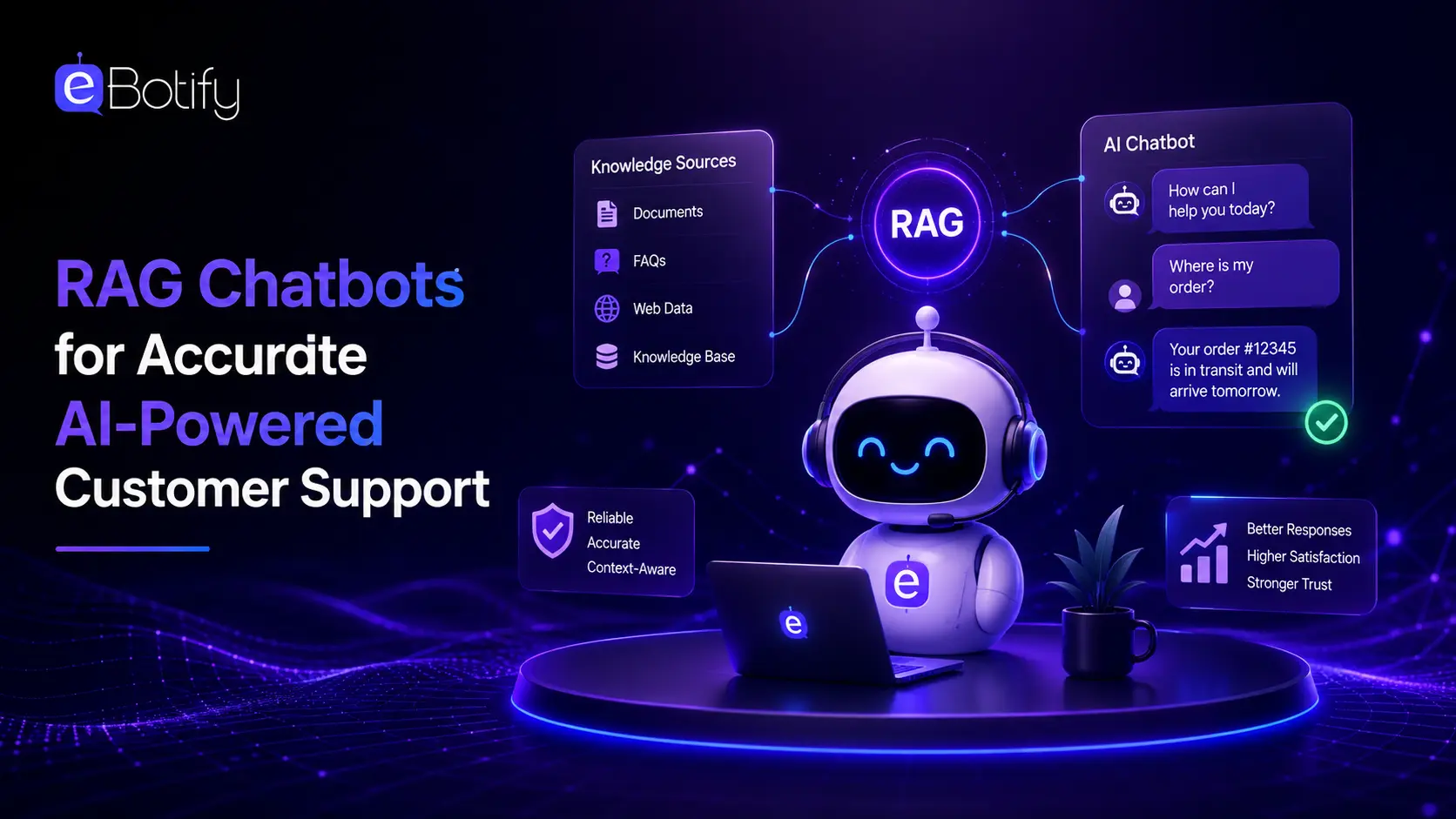
Unlike traditional chatbots, a generative AI chatbot uses large language models to understand context and predict meaningful responses. Many solutions also connect with business knowledge bases or live data through Retrieval Augmented Generation (RAG), helping them deliver more accurate, personalized, and up-to-date information.
Key Advantages of Generative AI Chatbot
1. 24/7 Customer Support
A conversational AI chatbot delivers instant assistance anytime, ensuring customers receive help without waiting for business hours.
2. Personalized Conversations
It understands user context and preferences to provide responses that feel more relevant and tailored.
3. Better Understanding of Queries
It interprets natural language and intent, making conversations smoother even when questions are complex.
4. Easy Scalability
It manages thousands of conversations at once without affecting response quality or increasing support costs.
5. Higher Team Productivity
It automates repetitive tasks, allowing employees to focus on complex issues that require human expertise.
6. Valuable Business Insights
It analyzes customer interactions to uncover trends, common concerns, and opportunities for service improvement.
What are Traditional Chatbots?
A traditional chatbot is a rule-based system that responds using predefined scripts, keywords, or decision trees. It follows programmed instructions instead of understanding the meaning behind a user’s message. These chatbots work well for answering common questions with predictable responses and structured conversation flows.
Unlike AI-powered solutions, traditional chatbots cannot generate original responses or adapt to unexpected questions. They guide users through fixed options and provide answers only when the input matches predefined rules. While effective for simple tasks, they often struggle with complex or natural conversations.
Advantages of Traditional Chatbots
1. Quick to Deploy
They can be set up faster because they rely on predefined conversation flows and responses.
2. Cost Effective
They are generally less expensive to build and maintain than advanced AI-powered chatbots.
3. Consistent Responses
They provide the same approved answers every time, reducing the risk of inconsistent information.
4. Easy to Manage
Businesses can update scripts and workflows without extensive technical expertise.
5. Ideal for Simple Tasks
They efficiently handle FAQs, appointment booking, order tracking, and other repetitive requests.
6. Reliable for Structured Workflows
They perform best when customer interactions follow clear, predictable paths.
Traditional Chatbots vs Generative AI Chatbots: What’s the Difference?
| Feature | Traditional Chatbot | Generative AI Chatbot |
| Response Style | Uses predefined replies based on rules and keywords. | Generates original responses based on context and intent. |
| Understanding | Handles only expected questions and fixed conversation paths. | Understands natural language, context, and follow-up questions. |
| Personalization | Provides the same responses to every user. | Delivers personalized interactions based on user needs and conversation history. |
| Complex Queries | Struggles with detailed or unexpected requests. | Handles complex questions with relevant and meaningful answers. |
| Learning Ability | Requires manual updates whenever new scenarios arise. | Improves through model updates and business knowledge integration. |
| Scalability | Suitable for simple, repetitive customer interactions. | Supports large-scale, dynamic conversations across multiple use cases. |
| Business Integrations | Connects with basic workflows and limited systems. | Integrates with CRMs, knowledge bases, and other business applications for richer responses. |
| Best For | FAQs, appointment scheduling, and basic customer support. | Customer support, sales, internal assistance, and personalized user experiences. |
A generative AI assistant goes beyond answering questions by understanding context, adapting to changing conversations, and delivering responses that feel more natural. While traditional chatbots remain useful for structured tasks, businesses that need intelligent, personalized interactions often benefit more from generative AI solutions.
Common Use Cases of Generative AI Chatbots
Businesses are using generative AI chatbots to improve customer experiences and automate everyday operations. A GPT-powered chatbot can support multiple teams by delivering fast, accurate, and personalized assistance across different business functions.
1. Customer Support
Resolve customer queries, process requests, and provide instant assistance while reducing response times.
2. Sales and Lead Generation
Answer product questions, recommend suitable solutions, qualify leads, and guide prospects through the buying journey.
3. Ecommerce Assistance
Help customers discover products, track orders, manage returns, and receive personalized shopping recommendations.
4. Employee Support
Assist employees with HR policies, IT troubleshooting, onboarding, and access to internal knowledge.
5. Healthcare Assistance
Schedule appointments, answer common patient questions, and provide general healthcare information while supporting administrative tasks.
6. Banking and Financial Services
Help customers check account information, explain financial products, and provide secure assistance for routine banking requests.
When Should Your Business Choose a Generative AI Chatbot?
Not every business needs advanced AI from the start, but customer expectations continue to evolve. An LLM chatbot becomes a valuable investment when rule-based automation no longer meets user needs or business goals.
- Your chatbot cannot answer questions beyond predefined scripts.
- Customers expect faster, more natural, and personalized conversations.
- Your support team spends significant time handling repetitive queries.
- You receive a high volume of customer requests every day.
- Your business serves customers across multiple languages or regions.
- You want to connect the chatbot with your CRM, knowledge base, or internal systems.
- You need an AI solution that can grow alongside your business and customer demands.
Ready to Transform Customer Conversations with eBotify?
Choosing the right chatbot depends on your business goals, customer expectations, and the complexity of daily interactions. While traditional chatbots handle routine tasks effectively, generative AI chatbots deliver more natural, personalized, and scalable experiences that help businesses improve customer satisfaction and operational efficiency.
eBotify helps businesses build intelligent generative AI chatbots tailored to their unique needs. From customer support to sales automation, our solutions create engaging experiences that grow with your business.
FAQs
1. Can a generative AI chatbot work alongside my existing chatbot?
Yes. Many businesses use a hybrid approach where traditional chatbots manage simple, repetitive queries while generative AI chatbots handle complex conversations. This improves customer experience without replacing existing systems immediately.
2. Does a generative AI chatbot require large amounts of business data?
Not always. A chatbot can start with publicly available knowledge or basic business information. As more internal documents, FAQs, and knowledge bases are integrated, its responses become increasingly accurate and relevant.
3. How do businesses ensure a generative AI chatbot provides accurate responses?
Businesses improve accuracy by connecting the chatbot to trusted knowledge sources, regularly updating information, setting response guidelines, and monitoring conversations. Human oversight also helps maintain quality and reliability over time.
4. Can a generative AI chatbot integrate with existing business tools?
Yes. Most modern generative AI chatbots can integrate with CRM platforms, help desk software, ecommerce systems, and internal databases. This allows them to access relevant information and deliver more personalized customer interactions.
5. Is a generative AI chatbot suitable for small and medium-sized businesses?
Absolutely. Small and medium-sized businesses can use generative AI chatbots to automate customer support, answer common questions, qualify leads, and improve response times without significantly increasing operational costs.