Key Takeaways
- 01
Facebook Messenger bots can help businesses respond to customers, answer common questions, and keep conversations moving without requiring a team member for every interaction. - 02
Businesses can use Messenger bots for marketing, lead generation, customer service, product discovery, and other conversational workflows. - 03
A Facebook Messenger chatbot can handle repetitive conversations while allowing human agents to take over when a request requires personal assistance. - 04
Effective Facebook Messenger automation should be built around clear customer needs, useful content, and well-defined business workflows. - 05
Businesses should balance automation with privacy, platform requirements, human handoff, and regular monitoring to maintain a useful customer experience.
A customer sends a message to your business on Facebook, but nobody from the team sees it for several hours. By the time someone responds, the customer may have already moved on. The same problem can happen when businesses receive repeated questions about products, services, pricing, availability, or support.
Facebook Messenger bots give businesses a way to handle many of these conversations directly inside Messenger. Instead of treating every message as a manual support task, businesses can use automation to answer common questions, collect information, guide customers, and start conversations that can later be handled by a human team member.
What are Facebook Messenger Bots?
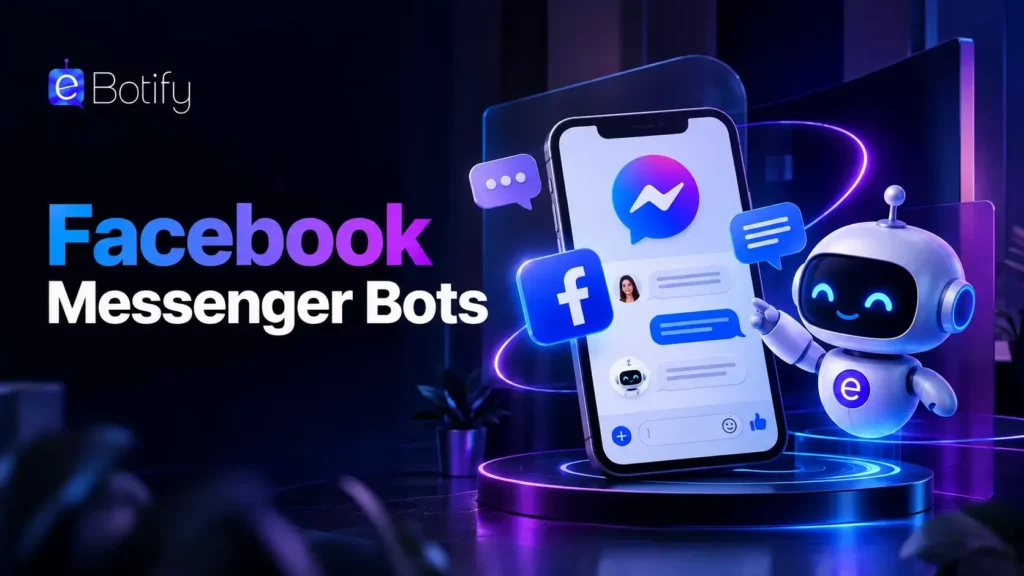
Facebook Messenger bots are automated systems designed to communicate with users through Facebook Messenger. A Messenger bot can respond to messages, provide information, ask questions, guide users through predefined workflows, and support different types of customer interactions.
A simple Messenger chatbot may rely on predefined responses and conversation paths. More advanced solutions can use artificial intelligence to understand natural language and respond to a wider range of customer requests.
For businesses, the important distinction is not simply whether a bot uses AI. The bigger question is what the bot is helping customers accomplish. A useful bot should make a specific interaction easier, faster, or more convenient.
Why Do Businesses Use Messenger Bots?
Facebook can be an important communication channel for businesses that already interact with customers through social media. When customers are comfortable sending messages through Messenger, adding automation can help businesses manage conversations without requiring employees to monitor every message manually.
Messenger bots for business can support several stages of the customer journey, from initial questions and product discovery to lead qualification and customer service.
1. Respond to Common Questions Quickly
Customers often ask similar questions repeatedly. They may want to know about business hours, product details, services, availability, delivery, pricing, or how to get started.
A Facebook Messenger chatbot can provide approved answers to these common questions without requiring an employee to respond manually each time. This can make basic information easier to access while reducing repetitive work for customer-facing teams.
2. Support Lead Generation
Messenger bots for lead generation can turn a basic social media conversation into an opportunity to collect useful information from potential customers.
For example, a bot could ask what product or service a person is interested in, their general requirements, or how they would prefer to be contacted. The information can then be passed to the appropriate sales process when the setup supports it.
This conversational approach can feel more natural than asking every visitor to leave Facebook and complete a separate form.
3. Provide Customer Service
A Facebook Messenger bot for customer service can handle routine support requests and provide customers with basic information through the same channel they already use to contact the business.
The bot can assist with simple questions while more complicated cases can be transferred to a human representative. This approach allows automation to support the service team without making every customer interaction dependent on automated responses.
4. Keep Conversations Available Outside Business Hours
Customers may send messages when a business team is offline. A Messenger bot can provide basic assistance during these periods, helping customers find information or understand what to do next.
For requests that need human attention, the bot can collect relevant information and set expectations about the next step. This gives customers a response instead of leaving them with an unanswered message.
5. Guide Customers Toward the Right Product or Service
Businesses with multiple products or services can use Messenger bots to help customers narrow down their options. A bot can ask simple questions about what the customer needs and provide relevant information based on their responses.
This can be useful for businesses where customers often need guidance before deciding which product, service, or package is appropriate for them.
6. Automate Repetitive Conversations
Facebook Messenger automation can reduce the amount of manual work involved in recurring conversations. Instead of responding to the same basic questions individually, businesses can create automated flows for common scenarios.
The goal should be selective automation. A bot does not need to handle every possible conversation. It should focus on interactions where automation provides a clear benefit and where the business can provide accurate answers.
How Businesses Can Use Facebook Messenger Bots
The right use case depends on the business model and the type of conversations customers already have with the company. Some common applications include:
- Product discovery: Help customers find relevant products based on their needs.
- Lead qualification: Ask questions and collect information from potential customers.
- Customer support: Provide answers to common questions and basic assistance.
- Appointment requests: Collect information from customers interested in booking a consultation or appointment.
- Order-related assistance: Help customers access basic information about orders or available support options.
- Marketing conversations: Engage users with relevant content, offers, or information where appropriate.
The most effective Messenger bots for marketing are usually connected to a clear objective. For example, the goal may be to help customers discover a product, answer questions about a campaign, or encourage an interested visitor to start a sales conversation.
Facebook Messenger Marketing With Chatbots
Facebook Messenger marketing can become more interactive when businesses use conversational experiences instead of relying only on static posts or advertisements. A Messenger chatbot can respond to users who engage with a business and guide them toward relevant information.
For example, a campaign promoting a new service could encourage users to start a Messenger conversation. The bot could explain the service, answer basic questions, and collect information from people who want to learn more.
However, automation should remain relevant to the customer’s intent. Sending repetitive or unrelated messages can quickly make the experience frustrating. Businesses should also follow Facebook’s applicable platform policies and messaging requirements when designing automated interactions.
What Is a Facebook Messenger AI Chatbot?
A Facebook Messenger AI chatbot uses artificial intelligence to understand and respond to user messages more flexibly than a purely rule-based bot. Instead of relying only on exact keywords or fixed buttons, it can interpret different ways of asking a similar question.
This can be useful when customers communicate naturally and do not follow a predefined conversation path. However, AI does not eliminate the need for good content, clear workflows, testing, or human support.
Businesses should define what the chatbot is allowed to answer, what information it can use, and when it should hand the conversation to a person. These boundaries help keep the customer experience useful and predictable.
What Should Businesses Consider Before Using Messenger Bots?
A Messenger bot should solve a real communication problem rather than being added simply because automation is available. Before implementation, businesses should consider how customers currently use Messenger and where the existing process creates delays or repetitive work.
- Customer intent: Identify the questions and tasks customers commonly bring to Messenger.
- Conversation design: Keep automated conversations short, clear, and easy to navigate.
- Human handoff: Define when a customer should be transferred to a team member.
- Data privacy: Be careful about what customer information is collected and stored.
- Content accuracy: Keep product, service, and support information current.
- Monitoring: Review conversations regularly to identify unanswered questions and workflow problems.
It is also worth starting with a limited set of use cases. Once the business understands how customers interact with the bot, additional workflows can be added based on actual needs and conversation data.
Make Messenger Conversations More Useful With Automation
Facebook Messenger bots can give businesses another way to manage customer conversations at scale. They can answer common questions, support lead generation, provide basic customer service, and guide users toward relevant products or services.
The most useful approach is to combine automation with clear business processes and human support. Platforms such as eBotify can help businesses create chatbot experiences around customer conversations while keeping the focus on practical use cases rather than automation for its own sake.
Frequently Asked Questions
1. What are Facebook Messenger bots?
Facebook Messenger bots are automated systems that communicate with users through Messenger. Businesses can use them to answer questions, provide information, generate leads, and support customer service.
2. How can Messenger bots help businesses?
Messenger bots can help businesses automate common conversations, respond to customers more quickly, collect lead information, provide basic support, and guide users toward relevant products or services.
3. Can Facebook Messenger bots generate leads?
Yes. Messenger bots for lead generation can ask qualifying questions, collect contact information, understand customer requirements, and pass relevant information into a sales workflow.
4. What is the difference between a Messenger chatbot and an AI chatbot?
A Messenger chatbot is designed to communicate through Facebook Messenger, while an AI chatbot uses artificial intelligence to understand and respond to user messages more flexibly. A Messenger chatbot can also use AI capabilities.
5. Can Messenger bots replace human customer service agents?
Messenger bots can handle many routine questions and tasks, but they should not be treated as a complete replacement for human agents. Complex, sensitive, or unusual requests may still require personal assistance.
18 Responses
I don’t think the title of your article matches the content lol. Just kidding, mainly because I had some doubts after reading the article. https://www.binance.info/register?ref=JW3W4Y3A
Can you be more specific about the content of your article? After reading it, I still have some doubts. Hope you can help me.
Your article helped me a lot, is there any more related content? Thanks! https://accounts.binance.bh/register/person?ref=IXBIAFVY
Thanks for sharing. I read many of your blog posts, cool, your blog is very good. https://www.binance.bh/register?ref=QCGZMHR6
Your point of view caught my eye and was very interesting. Thanks. I have a question for you.
Thank you for your sharing. I am worried that I lack creative ideas. It is your article that makes me full of hope. Thank you. But, I have a question, can you help me?
Your point of view caught my eye and was very interesting. Thanks. I have a question for you.
Your point of view caught my eye and was very interesting. Thanks. I have a question for you.
Your point of view caught my eye and was very interesting. Thanks. I have a question for you. https://www.binance.bh/futures/ref?code=L4EUT9FG
I don’t think the title of your article matches the content lol. Just kidding, mainly because I had some doubts after reading the article. https://www.binance.bh/register?ref=JW3W4Y3A
Thanks for shening. I read many of your blog posts, cool, your blog is very good. https://www.binance.bh/es-MX/register?ref=GJY4VW8W
Your point of view caught my eye and was very interesting. Thanks. I have a question for you.
Your article helped me a lot, is there any more related content? Thanks! https://www.binance.bh/register?ref=QCGZMHR6
Your article helped me a lot, is there any more related content? Thanks! https://accounts.binance.com/es-MX/register-person?ref=GJY4VW8W
Can you be more specific about the content of your article? After reading it, I still have some doubts. Hope you can help me.
LBtrHcHeOSYsVEZDh
Your article helped me a lot, is there any more related content? Thanks! https://www.binance.bh/register?ref=W49FLGDN
jwNwcWUmWvJpMXXfEbikAsMu