Key Takeaways
- 01
AI chatbots can provide students with faster access to important institutional information. - 02
Chatbots reduce repetitive enquiries while allowing staff to focus on complex student needs. - 03
Admissions, appointments, academic assistance, and campus services can benefit from conversational AI. - 04
Effective chatbot deployment requires accurate information, strong integrations, privacy, and human escalation. - 05
eBotify helps institutions build custom chatbots around their communication and operational workflows.
How quickly should a university answer a student who needs help with admission, fees, schedules, or campus services? What happens when that question arrives after office hours, or when hundreds of students ask similar questions at once? For institutions, keeping every student informed is becoming a daily operational challenge, not simply a service expectation.
This is where an education AI chatbot can add practical value. It gives students an immediate way to find reliable information while allowing staff to step in when a question needs human attention. As institutions explore AI across recruitment, student services, learning, and support, in this blog, we explore how chatbots can strengthen these experiences. So, let us dive in!
What is an Education AI Chatbot?
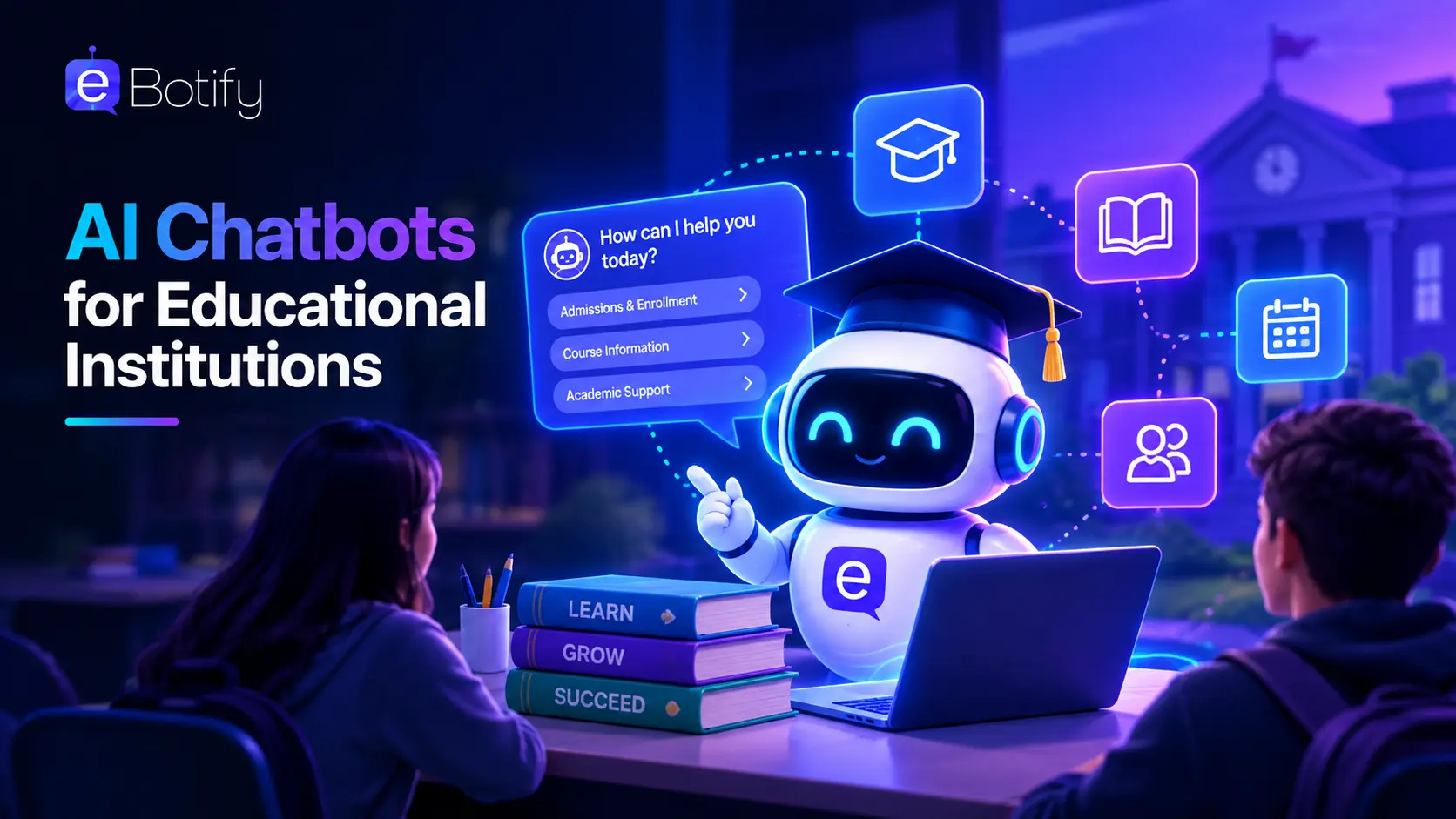
An education AI chatbot is a conversational system designed to help students, applicants, and staff access institutional information through natural language. Instead of searching through multiple webpages or waiting for an email response, users can ask questions in their own words and receive relevant answers based on the institution’s approved information.
The real value comes when the chatbot connects with an institution’s knowledge sources and existing systems. Course details, admission requirements, academic calendars, policies, student services, and frequently updated information can become accessible through one conversational interface. With the right integrations, the chatbot can also guide users through processes, collect information, schedule appointments, or transfer complex requests to the appropriate staff member.
Key Benefits of AI Chatbots for Educational Institutions
Educational institutions deal with a constant flow of questions, requests, and follow-ups. An AI chatbot can take care of many routine interactions while keeping students connected to the information they need. Its value becomes clearer when it is viewed as part of everyday student support rather than a standalone communication tool.
1. 24/7 access to information
Students can get answers to routine questions even when administrative offices are closed.
2. Faster responses
Common enquiries about admissions, courses, fees, schedules, and campus services can be addressed without waiting for staff.
3. Reduced administrative workload
Staff can spend less time handling repetitive questions and focus on cases that require human attention.
4. Consistent communication
A chatbot can provide responses based on approved institutional information, helping reduce inconsistencies across different communication channels.
5. Scalable student support
Institutions can manage high volumes of enquiries during admissions, enrollment, examinations, and other busy periods without placing the same pressure on support teams.
6. Better student engagement
Timely conversations can help students find relevant resources, services, and next steps without navigating complicated processes.
How Education AI Chatbots Strengthen Student Support?
Students rarely need support in one predictable way. One may be looking for an admission deadline, another may need help finding a campus service, while someone else may simply want to know where to submit a form. Handling these questions manually can quickly become repetitive for administrative teams.
An AI chatbot gives institutions a central conversational channel for these everyday interactions. It can answer routine questions, guide students toward relevant resources, provide updates, and escalate conversations when personal assistance is needed. This makes student support easier to access while giving staff more time to handle requests that require context, judgement, or direct intervention.
Common Areas Where Chatbots Can Help:
1. Admissions
Course requirements, application steps, deadlines, and document requirements.
2. Academic services
Timetables, academic calendars, course information, and institutional policies.
3. Campus services
Library, accommodation, transportation, facilities, and student activities.
4. Administrative queries
Fees, forms, payments, registrations, and service requests.
5. General guidance
Directing students to the right department, resource, or member of staff.
Key Use Cases of AI Chatbots in Education
AI chatbots can support several day-to-day interactions across admissions, academics, administration, and campus services. When connected with institutional systems, they can also contribute to education automation by handling routine tasks and guiding students through processes.
1. Admissions and Enquiries
Answer questions about courses, eligibility, deadlines, applications, and required documents. An admission chatbot can also capture prospective student details and direct complex enquiries to admissions teams.
2. Student Services
Help students find information about fees, schedules, policies, facilities, and campus resources. Common questions can be resolved without requiring staff intervention every time.
3. Academic Assistance
Provide access to course information, learning resources, academic calendars, and study-related guidance. Students can quickly find relevant information through a conversational interface.
4. Appointment Scheduling
Help students book appointments with admissions officers, advisors, counsellors, or other departments. The chatbot can collect basic details before confirming the request.
5. Application Follow-Ups
Send reminders about pending documents, upcoming deadlines, application updates, and enrollment steps. This keeps students informed without requiring repeated manual follow-ups.
6. Campus Information
Answer questions about libraries, accommodation, transportation, events, facilities, and student activities. Students can access this information through a single conversational channel.
What to Consider Before Deploying an Education AI Chatbot?
An AI chatbot interacts directly with students, applicants, and staff, so its implementation needs careful planning. The technology matters, but the quality of institutional data, integrations, governance, and escalation process will determine how useful it becomes.
1. Data privacy
Protect student information with appropriate access controls, data handling practices, and security measures.
2. Information accuracy
Keep the chatbot connected to current, approved institutional information to reduce outdated or incorrect responses.
3. Human escalation
Create clear paths for transferring sensitive, complex, or unresolved conversations to staff.
4. System integration
Connect the chatbot with relevant platforms such as CRMs, LMSs, student systems, helpdesks, and calendars.
5. Accessibility
Make the conversational experience usable across different devices, communication needs, and student groups.
6. Performance monitoring
Track unanswered questions, escalations, response quality, and user feedback to identify areas for improvement.
7. Clear ownership
Assign teams to maintain knowledge sources, review responses, and update chatbot workflows as institutional processes change.
How eBotify Helps Educational Institutions Build AI Chatbots?
eBotify helps educational institutions build custom AI chatbots around their student communication and support needs. These chatbots can assist with admissions, enquiries, appointments, lead qualification, and routine student services across multiple channels.
An admission chatbot can help prospective students understand courses, eligibility requirements, application steps, and deadlines while collecting relevant enquiry details. eBotify can also support:
1. Student Support
Answer routine questions and guide students to relevant resources.
2. Lead Qualification
Capture and organize prospective student enquiries.
3. Appointment Booking
Help students schedule meetings with the right department.
4. Multichannel Access
Deploy conversations across websites and popular messaging platforms.
5. Human Handoff
Transfer complex or sensitive conversations to staff when required.
6. Workflow Integration
Connect chatbot interactions with relevant business systems and processes.
The goal is to create a conversational experience that fits the institution’s existing workflows, rather than adding another disconnected support channel.
Could an Education AI Chatbot Transform Student Support?
An AI chatbot for education institutions can simplify everyday student interactions, support admissions, automate repetitive enquiries, and provide timely access to institutional information. With thoughtful integrations, governance, and human escalation, institutions can create a more responsive and connected student experience without removing human involvement.
eBotify helps educational institutions build custom AI chatbots for admissions, student support, lead qualification, appointments, and automated workflows. Its multichannel capabilities help institutions engage students through convenient digital channels while keeping complex interactions connected to the right teams.
FAQs
1. How can an Education AI Chatbot improve support during peak admission periods?
It can handle high enquiry volumes, answer routine questions, collect applicant details, and guide students through next steps without overloading admissions teams.
2. What happens when a chatbot cannot answer a student’s question?
The conversation can be transferred to an appropriate staff member, ensuring complex, sensitive, or unresolved requests receive human attention.
3. Can educational institutions connect chatbots with existing systems?
Yes. Chatbots can integrate with platforms such as CRMs, LMSs, calendars, helpdesks, and student information systems to support connected workflows.
4. Which chatbot metrics matter after deployment?
Resolution rates, escalation rates, unanswered queries, response quality, engagement, and student feedback can reveal where the chatbot performs well and needs improvement.
5. How can institutions keep chatbot responses reliable as information changes?
Regularly updating approved knowledge sources and monitoring conversations helps maintain accurate responses as courses, policies, deadlines, and institutional processes evolve.