Key Takeaways
- 01
Conversational AI is evolving into intelligent, goal-oriented business assistants. - 02
Multimodal interactions will create faster and more natural customer experiences. - 03
AI automation will streamline workflows beyond simple customer support tasks. - 04
Industry-specific AI assistants will outperform generic chatbot solutions. - 05
Responsible AI governance builds trust, security, and long-term business success.
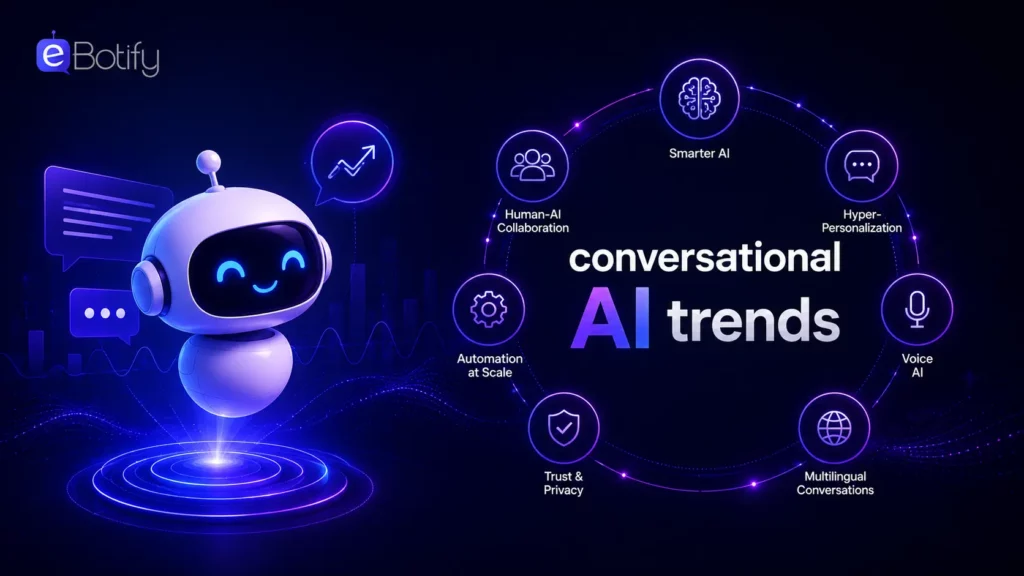
The rapid growth of conversational AI trends 2026 is changing how businesses interact with customers every day. Simple chatbots are evolving into intelligent AI assistants that understand context and respond naturally. These advancements are creating faster conversations, smarter decisions, and more meaningful customer experiences across industries.
As AI capabilities continue improving, businesses are exploring new ways to automate support, sales, and internal operations. Better reasoning, multimodal interactions, and autonomous actions are shaping the future of conversational AI. In this blog, we will explore the biggest conversational AI trends shaping 2026 and what they mean for businesses.
Want to reduce customer support costs while providing instant, 24/7 customer assistance? At Ebotify, we offer AI chatbot development services that automate support and enhance customer satisfaction.
Need a smarter way to reduce support costs and deliver 24/7 customer assistance? At Ebotify, we offer AI chatbot development services that automate interactions and elevate customer satisfaction.
What is Driving Conversational AI Growth in 2026?
The future of conversational AI is being shaped by changing customer expectations and rapid advances in artificial intelligence. Businesses are no longer adopting AI simply to answer questions. They want intelligent systems that improve experiences, reduce manual work, and support faster decision making.
At the same time, AI technologies have become more accessible and capable than ever before. This combination of business demand and technological progress is accelerating conversational AI adoption across industries and creating new opportunities for innovation.
1. Rising customer expectations
Customers expect instant, personalized, and consistent support across every digital channel.
2. Smarter AI models
Modern language models understand context better, deliver more accurate responses, and handle complex conversations naturally.
3. Growing demand for automation
Organizations are using conversational AI to automate repetitive tasks, improve efficiency, and reduce operational costs.
4. Multimodal AI capabilities
AI can now understand text, voice, images, and documents, creating more natural and flexible interactions.
5. Easy integration with business systems
Conversational AI connects with CRM, ERP, and other enterprise platforms to streamline workflows and access real-time information.
6. Greater accessibility of AI technology
Cloud platforms and AI development tools have made advanced conversational AI solutions easier and faster to deploy.
10 Conversational AI Trends to Watch in 2026
The next wave of conversational AI is focused on delivering greater intelligence, efficiency, and business value. These AI trends 2026 highlight how organizations can improve customer experiences while transforming everyday operations.
1. AI Agents Will Replace Traditional Chatbots
Traditional chatbots mainly answer predefined questions, while AI agents understand goals and complete tasks independently. Instead of only providing information, they can resolve issues, schedule appointments, and perform actions across connected systems. This shift will make business interactions faster and more outcome focused.
2. Multimodal Conversations Will Become Standard
Users will communicate naturally through text, voice, images, documents, and even videos within the same conversation. AI will understand different input formats without forcing users to switch between separate tools. This will create smoother and more intuitive digital experiences across every touchpoint.
3. Hyper-Personalized Customer Experiences
Conversational AI will use customer history, preferences, and context to deliver highly relevant interactions. Personalized recommendations and responses will improve engagement while reducing unnecessary back and forth. Businesses must also use customer data responsibly to maintain privacy and build lasting trust.
4. Voice AI Will Become More Human
Voice AI will deliver conversations that sound natural, responsive, and easier to understand. It will recognize emotional cues, respond in real time, and support AI phone agents handling customer requests efficiently. These improvements will make voice chatbots feel more conversational and helpful.
5. Conversational AI Will Power End-to-End Business Automation
The latest AI automation trends show conversational AI moving beyond answering questions to completing business processes. It will book appointments, create support tickets, process orders, update CRM records, and trigger workflows automatically. This will help organizations reduce manual work while improving operational efficiency.
6. Industry-Specific AI Assistants Will Grow Faster
Businesses are increasingly choosing AI assistants designed for industries such as healthcare, banking, retail, education, SaaS, and manufacturing. Unlike generic chatbots, these solutions understand industry terminology, regulations, and workflows. This is one of the most important chatbot trends 2026 because specialized AI delivers more accurate and valuable outcomes.
7. Stronger AI Governance and Compliance
As conversational AI becomes more capable, businesses will place greater importance on responsible AI practices. Privacy, explainability, secure deployments, human oversight, and regulatory compliance will become essential for building trustworthy AI solutions. Strong governance will help organizations reduce risks while increasing user confidence.
8. Seamless Omnichannel Conversations
Customers will expect conversations to continue smoothly across websites, WhatsApp, mobile apps, email, and social media. AI will remember previous interactions, allowing users to switch channels without repeating information. This consistency will improve customer satisfaction and strengthen long-term engagement.
9. Better Integration with Enterprise Systems
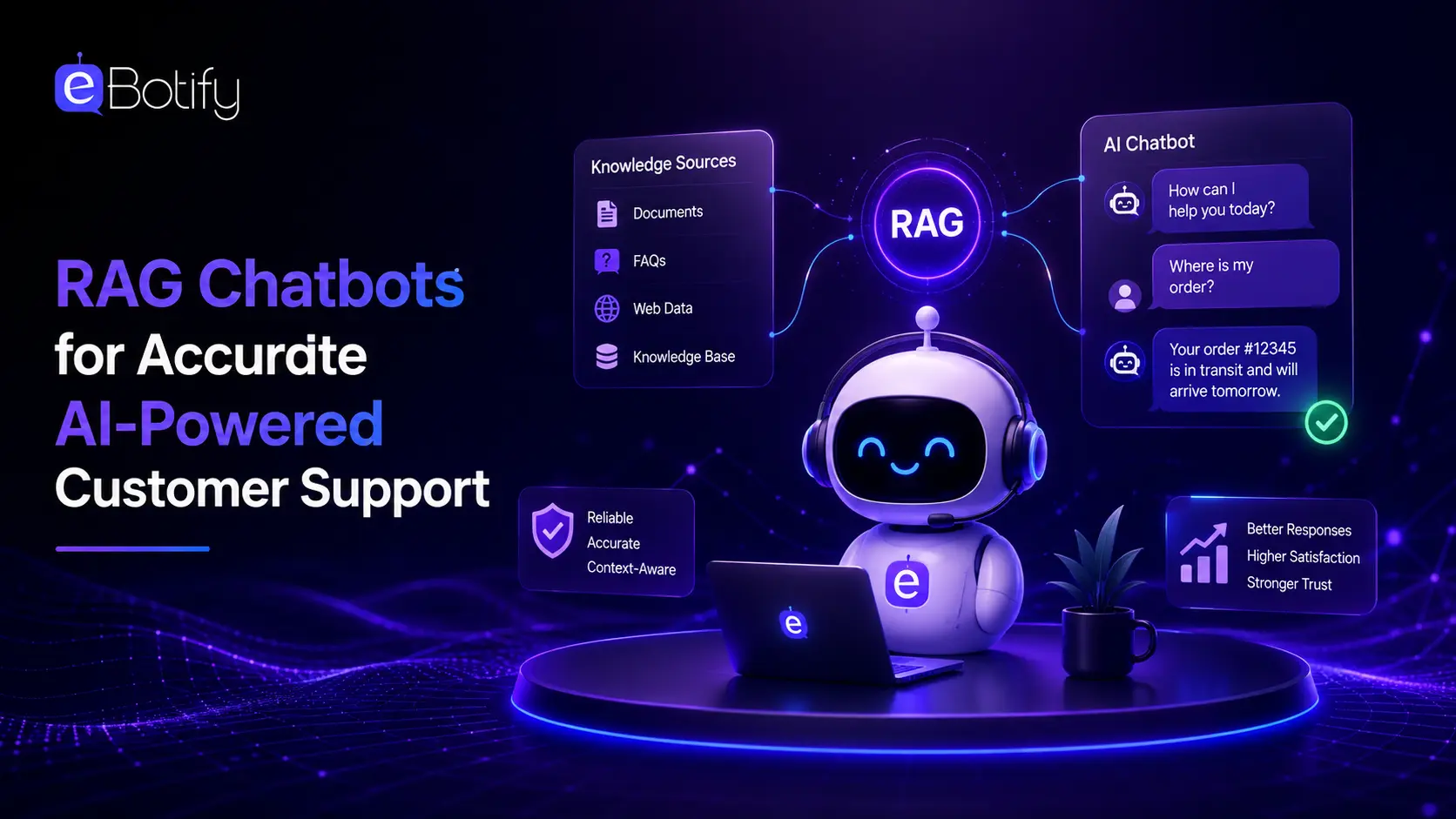
Conversational AI will connect seamlessly with CRM, ERP, HR software, knowledge bases, and other business platforms. Technologies such as Retrieval-Augmented Generation (RAG) will help AI access accurate company information before generating responses. This conversational AI trends 2026 will improve reliability while supporting faster business decisions.
10. AI Will Become a Digital Employee
Conversational AI will increasingly support employees by handling repetitive tasks, generating reports, summarizing meetings, and assisting with decision making. Rather than replacing people, it will work alongside teams to improve productivity and reduce routine workloads. This evolution reflects the future of conversational AI, where intelligent assistants become an integral part of everyday business operations.
Challenges Businesses Should Prepare For
As conversational AI continues evolving, businesses should prepare for a few practical challenges during implementation. Addressing these early can improve performance, strengthen user confidence, and support long-term success.
1. Data Privacy
Protect sensitive customer information through secure storage, encryption, and access controls.
2. AI Hallucinations
Regularly validate AI responses using trusted data and human oversight.
3. Integration Complexity
Plan seamless integration with existing systems to avoid workflow disruptions.
4. User Trustan Businesses
Ensure transparent AI interactions and provide human support when needed.
5. Continuous Model Improvement
Monitor performance regularly and update AI models using quality feedback.
How Can Businesses Prepare for the Future of Conversational AI?
Keeping pace with conversational AI trends 2026 requires a clear strategy instead of simply adopting the latest technology. Businesses that align AI initiatives with long-term objectives will be better positioned to improve customer experiences and operational efficiency while adapting to emerging AI automation trends.
1. Start with clear business goals
Identify specific problems AI should solve before implementation.
2. Choose scalable AI platforms
Select solutions that can grow alongside business needs.
3. Invest in quality data
Reliable and organized data improves AI accuracy and decision making.
4. Integrate AI with existing systems
Connect AI with business tools for seamless workflows.
5. Monitor AI performance continuously
Track outcomes and refine models based on real-world results.
6. Balance automation with human support
Keep human expertise available for complex or sensitive interactions.
Ready to Transform Customer Conversations with AI?
Conversational AI is advancing beyond simple automation to become an intelligent business partner. Organizations that embrace these innovations today can improve customer experiences, streamline operations, and stay prepared for changing market expectations. Strategic adoption will create lasting value throughout 2026 and beyond.
eBotify helps businesses deploy intelligent conversational AI solutions that automate support, engage customers, and simplify everyday workflows. Whether you need an AI chatbot, virtual assistant, or industry-specific solution, eBotify can help you build smarter conversations that deliver measurable business results.
FAQs
1. How can businesses measure the success of conversational AI?
Businesses should track metrics such as customer satisfaction, response time, resolution rate, lead conversion, cost savings, and user engagement. Monitoring these indicators helps identify improvement opportunities and ensures conversational AI delivers measurable business value over time.
2. Should businesses build custom conversational AI or use ready-made solutions?
The right choice depends on business goals, complexity, and scalability needs. Ready-made solutions work well for basic use cases, while custom conversational AI offers greater flexibility, deeper integrations, and industry-specific capabilities for long-term growth.
3. How long does it take to implement a conversational AI solution?
Implementation timelines vary based on project scope, integrations, and customization requirements. Simple deployments may take a few weeks, while enterprise-grade conversational AI solutions with multiple workflows can require several months to complete successfully.
4. Can conversational AI support multiple languages and global customers?
Yes. Modern conversational AI platforms can understand and respond in multiple languages while maintaining context across conversations. This helps businesses provide consistent customer support and personalized experiences for users in different regions.
5. What should businesses consider before scaling conversational AI?
Before expanding conversational AI, businesses should evaluate data quality, integration readiness, security requirements, governance policies, and ongoing performance monitoring. A scalable strategy ensures the solution continues delivering accurate, reliable, and efficient customer interactions.