
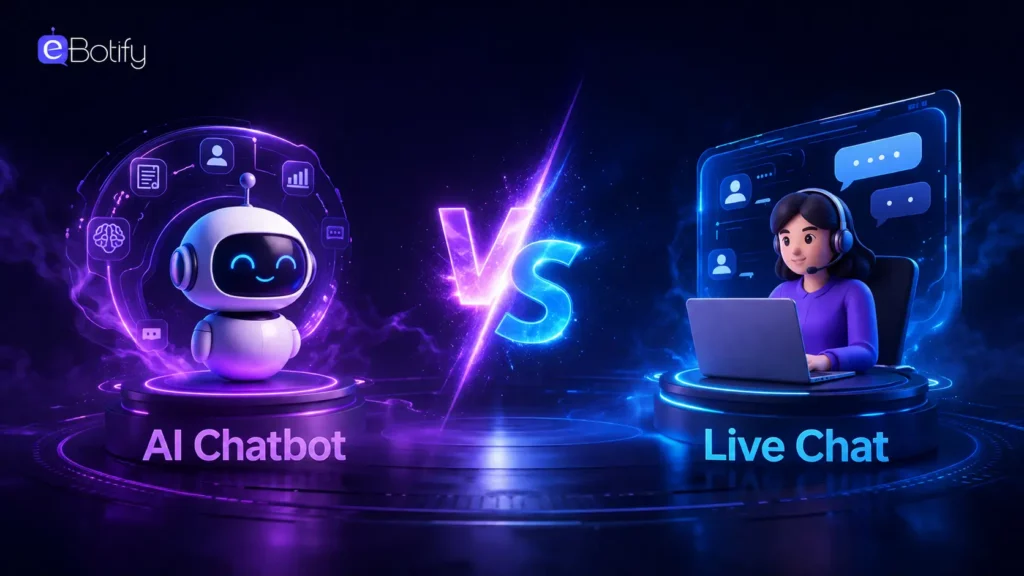
Key Takeaways
- 01
AI chatbots deliver instant, scalable, and always available customer support. - 02
Live chat provides personalized assistance for complex customer conversations. - 03
Combining both solutions creates a faster and better support experience. - 04
Business goals determine the right customer support approach and technology. - 05
AI automation reduces costs while improving operational efficiency and customer satisfaction.
The debate around AI chatbot vs live chat has become more important as customer expectations continue rising. Modern customers expect quick, accurate, and personalized support without waiting for long response times. Businesses must now decide how to deliver better service while controlling operational costs and maintaining consistent customer experiences.
Choosing the right solution depends on your support goals, customer needs, and conversation volume. Both options offer unique strengths, but each serves different business situations and customer expectations. In this blog, we compare AI chatbots and live chat to help you choose the right customer support solution. Let’s keep reading further!
Want to reduce customer support costs while delivering instant, 24/7 assistance? At Ebotify, we offer end-to-end AI chatbot development services that streamline operations and enhance customer satisfaction.
What is an AI Chatbot? A Quick Overview
An AI chatbot is a software application that interacts with users through text or voice conversations. Unlike traditional chatbots that follow predefined rules, it uses Natural Language Processing (NLP), Machine Learning (ML), and Large Language Models (LLMs) to understand user intent, interpret context, and deliver relevant responses.
When a user asks a question, the chatbot analyzes the message to understand its meaning and identify the intended request. It then extracts important details, searches available information when needed, and generates a natural response. AI chatbots can automate tasks such as answering FAQs, booking appointments, qualifying leads, tracking orders, and resolving common customer queries.
Key Advantages of AI Chatbot at a Glance
Businesses investing in AI-powered customer support gain several chatbot advantages that improve both operational efficiency and customer satisfaction.
1. 24/7 Availability
AI chatbots provide instant support at any time, ensuring customers receive assistance without waiting for business hours.
2. Cost Efficiency and Scalability
They manage thousands of customer conversations simultaneously without increasing support staff or operational costs.
3. Personalized Customer Experiences
AI chatbots use customer data and CRM integrations to deliver relevant recommendations and tailored responses.
4. Automated Lead Generation
They qualify prospects, collect customer information, and guide potential buyers through the sales journey.
5. Consistent Support Across Channels
AI chatbots maintain the same brand voice and service quality across websites, messaging apps, and social platforms.
6. Multilingual Customer Support
They help businesses serve global audiences by communicating with customers in multiple languages.
Drawbacks to Watch Out For
1. Risk of Inaccurate Responses
AI may occasionally provide incorrect information without proper monitoring.
2. Limited Emotional Understanding
Chatbots cannot fully understand emotions during sensitive customer interactions.
3. Data Security Concerns
Handling customer data requires strong security measures and regulatory compliance.
4. Ongoing Maintenance Requirements
AI chatbots need regular updates, training, and performance optimization.
5. Integration Challenges
Connecting chatbots with existing systems can require significant technical effort.
6. Dependence on Automation
Poor human handoffs may frustrate customers with complex support needs.
What is a Live Chat? A Quick Overview
Live chat is a real-time messaging tool that helps businesses communicate with website or app visitors instantly. In the chatbot vs live chat discussion, live chat focuses on direct conversations with human support agents, making it suitable for customers who need personalized assistance or detailed problem resolution.
When a customer starts a conversation through the chat widget, the message is routed to an available support agent or an AI chatbot based on the setup. Live chat helps businesses answer product questions, resolve technical issues, process bookings, manage customer accounts, capture leads, and provide quick assistance during the buying journey.
Key Advantages of Live Chat at a Glance
In an AI chatbot comparison, live chat continues to play an important role by offering personalized support and real-time customer engagement.
1. Instant Customer Assistance
Live chat connects customers with support agents for immediate responses and faster issue resolution.
2. Higher Sales Conversions
Quick answers to purchase questions help reduce cart abandonment and increase conversions.
3. Cost-Effective Customer Support
Agents can manage multiple conversations at once, improving overall support efficiency.
4. Proactive Customer Engagement
Businesses can reach visitors at the right moment to offer timely guidance and assistance.
5. Better Customer Insights
Live chat collects valuable customer information that supports personalized communication and follow ups.
6. Improved Business Decisions
Chat conversations reveal customer concerns and preferences, helping businesses refine products and services.
Drawbacks to Watch Out For
1. High Response Expectations
Delayed replies can quickly reduce customer satisfaction and trust.
2. Limited Human Expression
Text conversations may feel less personal without verbal or visual cues.
3. Risk of Miscommunication
Short messages can sometimes create confusion or misunderstand customer intent.
4. Difficult for Complex Issues
Detailed technical problems often require calls or screen sharing.
5. Higher Staffing Requirements
Maintaining real-time support demands trained agents and continuous availability.
6. Privacy and Security Concerns
Businesses must protect sensitive customer information during live conversations.
Live Chat vs Chatbot: Key Differences
Choosing between AI chatbot vs live chat requires understanding how each solution performs in real customer support scenarios. While both help businesses engage customers quickly, they differ in automation, availability, scalability, cost, and the type of support they deliver.
| Feature | AI Chatbot | Live Chat |
| Availability | Available 24/7 without breaks or business hours. | Depends on agent availability and working hours. |
| Response Speed | Delivers instant responses within seconds. | Response time varies based on agent workload. |
| Scalability | Handles thousands of conversations simultaneously. | Limited by the number of available agents. |
| Cost Efficiency | Reduces long-term support and staffing costs. | Requires ongoing investment in support teams. |
| Routine Query Handling | Automates FAQs, bookings, tracking, and common requests. | Best suited for personalized customer assistance. |
| Complex Issue Resolution | Escalates complex cases to human agents. | Resolves technical and sensitive issues effectively. |
| Lead Generation | Qualifies leads and captures customer information automatically. | Collects leads through direct agent conversations. |
| Consistency | Provides accurate, standardized responses across every interaction. | Response quality varies with individual agents. |
| Multilingual Support | Supports multiple languages without additional hiring. | Requires multilingual agents for global support. |
| Business Growth | Easily scales as customer inquiries increase. | Scaling requires recruiting and training more agents. |
When Should You Choose an AI Chatbot?
Businesses investing in customer support automation should consider an AI chatbot when these needs align with their support strategy.
1. High Support Volume
Manage large numbers of customer conversations without increasing staff.
2. Frequently Asked Questions
Instantly answer repetitive customer queries with consistent responses.
3. Round-the-Clock Availability
Provide support anytime without depending on business hours.
4. Lead Qualification
Capture and qualify potential customers before human involvement.
5. Routine Business Processes
Automate bookings, order tracking, and appointment scheduling efficiently.
6. Growing Business Operations
Scale customer support easily as inquiry volumes continue increasing.
When is Live Chat the Better Option?
Live chat is the right choice when customers need personalized assistance that requires human expertise and real-time interaction.
1. Urgent Customer Questions
Resolve time-sensitive queries through immediate conversations with support agents.
2. Complex Customer Issues
Handle technical, sensitive, or detailed concerns requiring human judgment.
3. File and Information Sharing
Exchange screenshots, documents, links, and order details effortlessly.
4. Documented Conversations
Maintain chat transcripts for future reference and issue tracking.
5. Personalized Buying Assistance
Help customers make informed purchasing decisions through direct guidance.
6. High-Value Customer Interactions
Build trust with personalized conversations for important customer relationships.
Ready to Transform Your Customer Support with AI?
The chatbot vs live chat decision depends on your business goals, customer expectations, and support requirements. AI chatbots excel at automation, speed, and scalability, while live chat delivers personalized assistance for complex conversations. Many businesses achieve the best results by combining both solutions.
At eBotify, we help businesses build intelligent AI chatbot solutions that automate customer support without compromising customer experience. Whether you want faster responses, higher engagement, or scalable support operations, our AI-powered chatbots are designed to help your business grow with confidence.
FAQs
1. Can an AI chatbot and live chat work together?
Yes. Many businesses use AI chatbots to answer routine questions, collect customer information, and qualify leads before transferring complex conversations to live agents. This hybrid approach improves response times while ensuring customers receive human support whenever needed.
2. Does an AI chatbot improve customer satisfaction?
Yes, when implemented correctly. AI chatbots provide instant responses, reduce waiting times, and offer round the clock support. However, they should also include smooth handoffs to human agents for complex or sensitive customer concerns.
3. Is live chat more expensive than an AI chatbot?
Live chat usually involves higher ongoing costs because businesses need trained support agents to manage conversations. AI chatbots require an initial investment but can handle large conversation volumes, making them more cost effective over time.
4. What should businesses consider before implementing an AI chatbot?
Businesses should evaluate customer inquiry types, integration requirements, security standards, expected support volume, and future growth plans. Choosing a chatbot that integrates with existing systems helps deliver a better customer experience and long term value.
5. Which industries benefit the most from AI chatbots?
Industries such as ecommerce, healthcare, banking, education, travel, real estate, and SaaS benefit significantly. AI chatbots automate repetitive customer interactions, improve response times, and support business growth without increasing support workloads.


17 Responses
Thank you for your sharing. I am worried that I lack creative ideas. It is your article that makes me full of hope. Thank you. But, I have a question, can you help me? https://accounts.binance.com/register/person?ref=IXBIAFVY
Can you be more specific about the content of your article? After reading it, I still have some doubts. Hope you can help me.
Your point of view caught my eye and was very interesting. Thanks. I have a question for you.
Your point of view caught my eye and was very interesting. Thanks. I have a question for you. https://www.binance.bh/register?ref=JW3W4Y3A
I don’t think the title of your article matches the content lol. Just kidding, mainly because I had some doubts after reading the article.
Can you be more specific about the content of your article? After reading it, I still have some doubts. Hope you can help me.
I don’t think the title of your article matches the content lol. Just kidding, mainly because I had some doubts after reading the article.
Can you be more specific about the content of your article? After reading it, I still have some doubts. Hope you can help me. 注册Binance
I don’t think the title of your article matches the content lol. Just kidding, mainly because I had some doubts after reading the article.
Your article helped me a lot, is there any more related content? Thanks! https://www.binance.com/register?ref=JW3W4Y3A
Thanks for sharing. I read many of your blog posts, cool, your blog is very good. https://www.binance.com/register?ref=GGYHGRE
I don’t think the title of your article matches the content lol. Just kidding, mainly because I had some doubts after reading the article. https://www.binance.bh/register?ref=W49FLGDN
Thank you for your sharing. I am worried that I lack creative ideas. It is your article that makes me full of hope. Thank you. But, I have a question, can you help me? https://accounts.binance.bh/en-KZ/register?ref=I3OM7SCZ
Can you be more specific about the content of your article? After reading it, I still have some doubts. Hope you can help me.
I don’t think the title of your article matches the content lol. Just kidding, mainly because I had some doubts after reading the article.
Thank you for your sharing. I am worried that I lack creative ideas. It is your article that makes me full of hope. Thank you. But, I have a question, can you help me? https://www.binance.bh/ar-BH/register?ref=S5H7X3LP