Key Takeaways
- 01
AI chatbots for business help automate routine conversations, answer customer questions, qualify leads, and support everyday business workflows. - 02
Different industries can use chatbots for tasks such as product discovery, appointment scheduling, order assistance, and customer support. - 03
The benefits of AI chatbots for business depend on choosing relevant use cases, maintaining accurate information, and connecting the right systems. - 04
Business chatbot solutions can support sales, marketing, and customer service when automated workflows align with real customer needs. - 05
Successful chatbot implementation requires reliable integrations, data protection, performance measurement, and clear options for human assistance.
Businesses handle a steady stream of questions, requests, and repetitive tasks every day. Customers want quick answers about products, services, orders, and appointments, while employees spend time collecting information, responding to routine inquiries, and updating records. When these activities grow, maintaining a consistent customer experience becomes more difficult.
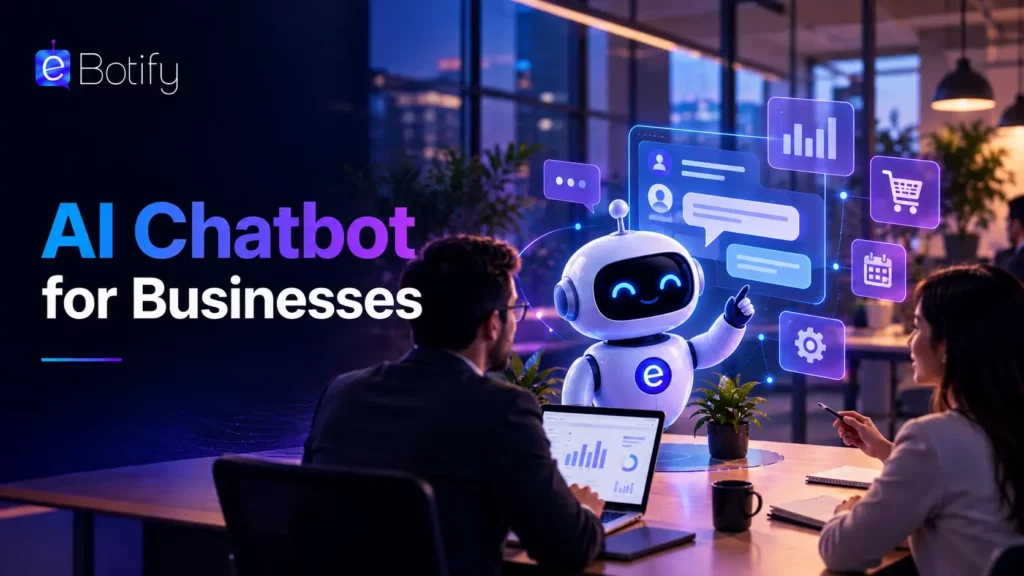
AI chatbots for business offer a practical way to manage many of these interactions through automated conversations. They can help customers find information, guide prospects through buying decisions, and connect conversations with existing business processes. Their applications extend across industries, but the most effective implementations start with a clear business need rather than adding automation without a defined purpose.
What are AI Chatbots for Business?
AI chatbots for business are conversational software tools that use artificial intelligence to understand user requests and provide relevant responses or assistance. They can operate on websites, messaging platforms, mobile applications, and customer portals, depending on how they are deployed.
Traditional chatbots often follow predefined rules and conversation paths. AI-powered systems can use natural language processing and generative AI to interpret different ways of asking the same question, maintain conversational context, and respond more flexibly. Some can also retrieve information from connected business systems or initiate specific workflows.
For example, a visitor on a software company’s website might ask whether a product supports a particular integration. A chatbot can provide an answer based on approved product documentation and offer to connect the visitor with the sales team if further discussion is needed.
The capabilities of a chatbot depend on its design, data sources, permissions, and integrations. A system that answers questions may not automatically be able to process an order or update a customer account unless the appropriate functionality is available.
Benefits of AI Chatbots for Business
The benefits of AI chatbots for business go beyond providing automated answers. When implemented carefully, they can improve access to information, support customer engagement, and reduce repetitive work across departments.
1. Faster Responses to Common Questions
Chatbots can respond to frequently asked questions without requiring customers to wait for an employee. They can provide information about services, product features, opening hours, policies, and common procedures, helping users find answers at convenient times.
2. More Efficient Lead Generation
Chatbots for lead generation can ask relevant questions, collect contact details, understand customer requirements, and route suitable prospects to sales teams. Instead of collecting only basic information through a form, businesses can use conversational interactions to understand what a prospect actually needs.
3. Reduced Repetitive Work
Employees often spend time answering similar questions or gathering information before they can address a request. Chatbot automation for businesses can handle suitable routine tasks, allowing teams to focus on complex issues, relationship building, and decisions that require human judgment.
4. More Consistent Customer Experiences
A chatbot that uses approved information can provide consistent answers across common interactions. Businesses still need to maintain that information and review responses, but a structured approach can reduce confusion caused by outdated instructions or inconsistent explanations.
5. Better Access to Business Information
When connected to relevant knowledge sources, chatbots can help customers and employees find information without searching through multiple pages or documents. This is particularly useful for businesses with extensive product catalogs, service documentation, or frequently updated policies.
AI Chatbot Applications in Business Across Different Industries
AI chatbot applications in business vary according to the products, services, and customer expectations of each industry. A retail chatbot may focus on product discovery, while a healthcare organization may use one to guide patients through appointment-related information.
| Industry | Common Chatbot Application | Potential Business Value |
|---|---|---|
| Ecommerce and retail | Product discovery, order questions, and return guidance. | Helps customers navigate the shopping journey. |
| Healthcare | Appointment information, clinic FAQs, and administrative guidance. | Reduces repetitive administrative inquiries. |
| Banking and finance | General service information and guidance on routine processes. | Improves access to approved service information. |
| Travel and hospitality | Booking inquiries, itinerary information, and hotel FAQs. | Simplifies access to travel-related assistance. |
| Education | Course information, admission requirements, and application guidance. | Helps prospective students find relevant information. |
| SaaS and technology | Product questions, technical guidance, and demo qualification. | Supports customer onboarding and sales inquiries. |
1. Ecommerce and Retail
Retail businesses can use AI chatbots to help shoppers find products, compare features, understand delivery policies, and locate order information. For example, a shopper looking for a particular type of product could describe their requirements and receive suggestions based on available catalog information.
When connected to suitable systems, the chatbot may also support order-related workflows. Businesses should ensure that product availability, prices, and policy details are retrieved from reliable sources.
2. Healthcare and Wellness Services
Healthcare providers can use chatbots to share clinic hours, explain appointment procedures, provide general administrative information, and guide patients toward the appropriate department. These applications can reduce repetitive inquiries while helping patients understand the next step.
Sensitive health questions require additional care. Chatbots should not replace qualified medical professionals, and organizations must protect personal information and follow applicable privacy requirements.
3. Banking and Financial Services
Financial institutions can use chatbots to answer general questions about services, explain routine procedures, and direct customers to relevant support channels. Account-specific assistance requires appropriate authentication, access controls, and carefully defined permissions.
For sensitive transactions or disputed financial activity, businesses should provide a clear route to authorized staff rather than relying entirely on automated responses.
4. Travel and Hospitality
Hotels, travel agencies, and tour operators can use chatbots to answer questions about packages, amenities, reservation procedures, and travel policies. A connected assistant may also help retrieve booking information or guide customers through the next step in a reservation process.
5. Education and SaaS
Educational institutions can use chatbots to explain course options, admission requirements, and application steps. SaaS companies can provide product guidance, answer common support questions, and collect details from visitors interested in a demonstration.
In both cases, the chatbot can help users find relevant information while directing complex questions to the appropriate staff member.
Business Chatbot Use Cases Across Departments
Chatbots can also support multiple departments within the same organization. Instead of treating automation as a customer service feature alone, businesses can identify repetitive conversational tasks across sales, marketing, support, and internal operations.
| Department | Business Chatbot Use Case | Example Workflow |
|---|---|---|
| Customer service | Answer routine questions and collect issue details. | Provide an answer or route the case to support. |
| Sales | Qualify prospects and identify requirements. | Collect lead details and schedule a consultation. |
| Marketing | Engage visitors and share relevant resources. | Guide an interested visitor toward a signup. |
| Human resources | Answer routine employee questions. | Explain policies or direct employees to resources. |
| Operations | Help employees locate procedures and information. | Retrieve an approved internal guide. |
These workflows illustrate how business process automation with chatbots can connect conversations to practical tasks. The goal is to reduce unnecessary manual steps while keeping employees involved when a request requires approval, specialized knowledge, or personal attention.
AI Chatbots for Sales and Customer Service
Sales and support are two common areas where chatbots can assist customers throughout their relationship with a business. However, each department has different objectives, so the chatbot should be configured accordingly.
Supporting Sales Conversations
AI chatbots for sales can answer preliminary product questions, identify customer requirements, collect lead details, and arrange follow-up conversations. A prospect evaluating business software, for instance, could describe their needs and request a demonstration when they are ready.
The chatbot should collect only useful information and pass it to the sales team with enough context to support a relevant follow-up. It should not invent product capabilities or make promises that the business cannot fulfill.
Improving Customer Service
AI chatbots for customer service can handle common inquiries, guide users through troubleshooting steps, and retrieve relevant information from approved knowledge sources. If a problem cannot be resolved, the chatbot should explain how to contact a support representative and share the details already collected.
This combination of automation and human support helps businesses manage routine interactions without forcing customers to rely on a chatbot for every problem.
Choosing Business AI Chatbot Solutions
The right business AI chatbot solutions depend on the organization’s goals, systems, customer needs, and available resources. A small business may start with an FAQ assistant, while a larger organization may require CRM integration, multiple communication channels, and more complex workflows.
Before choosing a platform, evaluate these factors:
- Business objectives: Identify whether the priority is customer support, lead generation, sales assistance, or internal automation.
- Ease of management: Check whether the team can update information and maintain conversation flows.
- Integration capabilities: Determine whether the chatbot can connect to the CRM, help desk, ordering platform, or other required systems.
- Data privacy and security: Review how information is collected, accessed, stored, and protected.
- Human handoff: Ensure users can reach the appropriate employee when automation is insufficient.
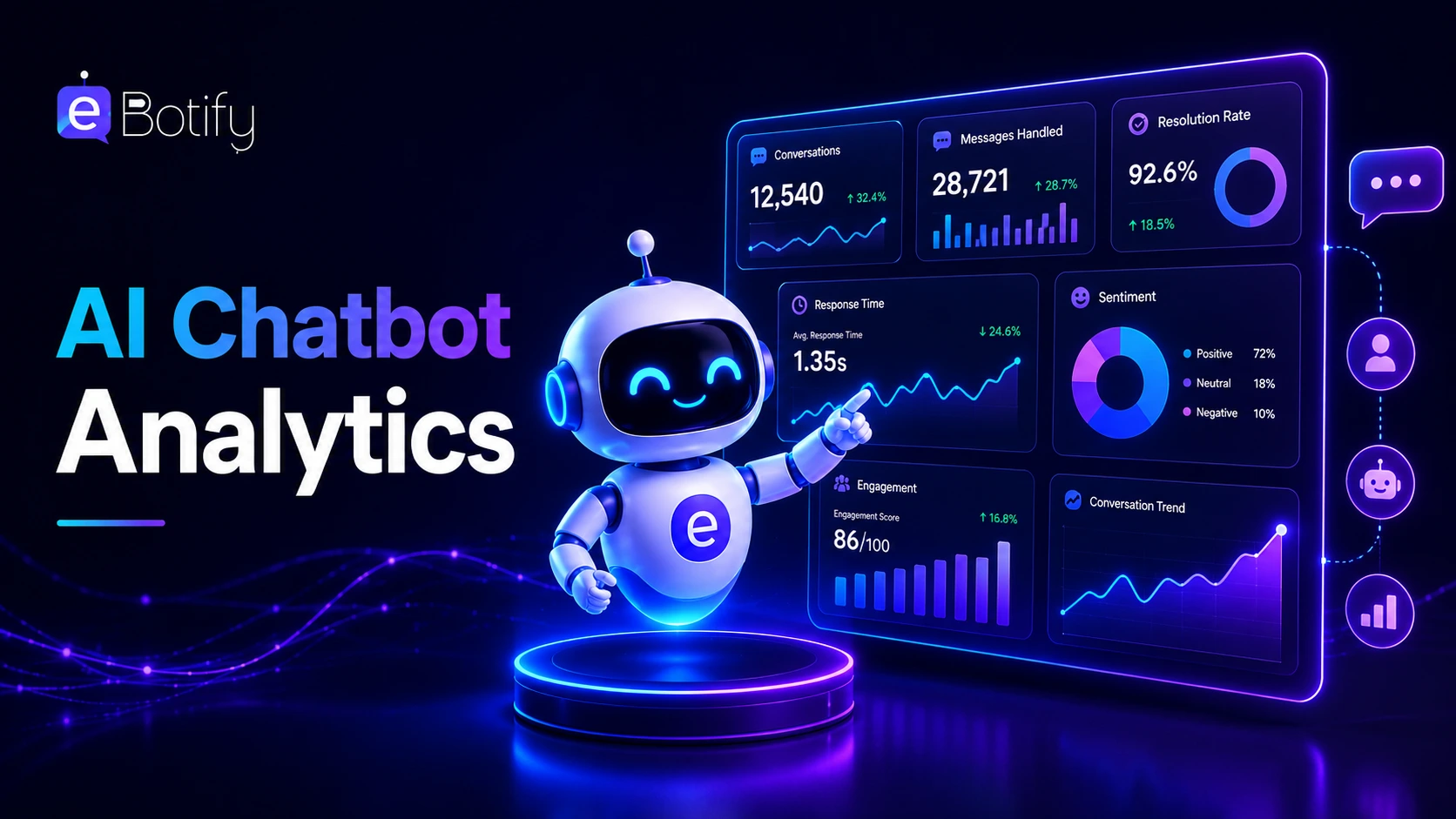
- Reporting and analytics: Look for ways to review engagement, task completion, unresolved questions, and customer feedback.
Platforms such as eBotify can help businesses create and deploy chatbot experiences for customer conversations and automated workflows. Businesses should assess the platform’s available capabilities and integrations against their specific requirements before selecting a solution.
Challenges to Consider Before Implementing AI Chatbots
AI chatbots can improve access to information, but they also introduce practical considerations. Incorrect answers, outdated knowledge, and poorly configured workflows can create confusion or increase the workload for employees. Businesses need a process for reviewing responses and keeping information current.
Integration complexity can also affect implementation. A chatbot may answer questions successfully but still be unable to complete an order, update a record, or retrieve account information without the appropriate system connection. These capabilities should be tested before the chatbot is made available to customers.
Organizations should also establish privacy controls, define what the chatbot is allowed to do, and monitor its performance. Starting with a limited use case makes it easier to identify issues and improve the experience before expanding automation to additional departments.
Build Better Business Workflows With AI Chatbots
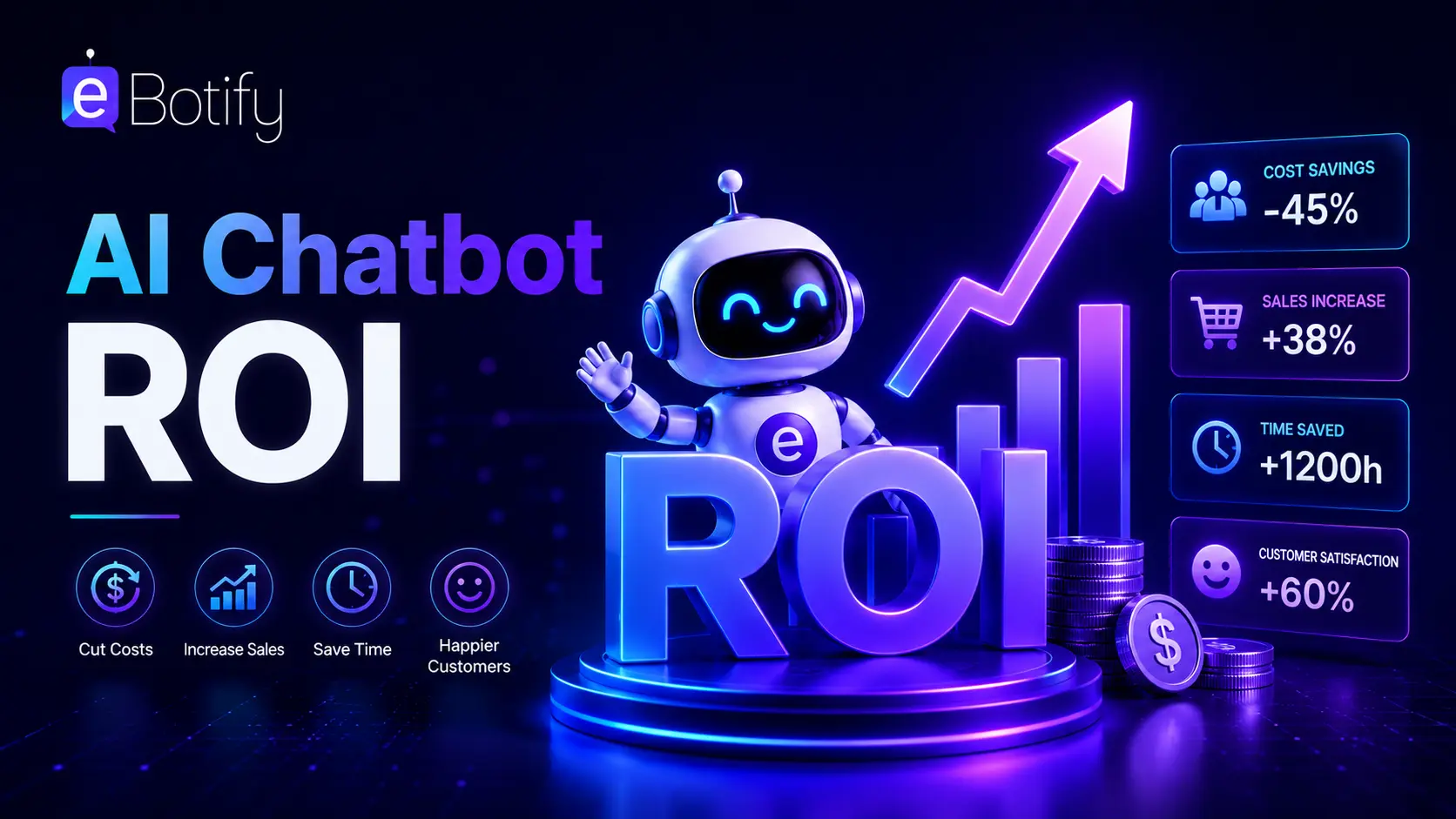
AI chatbots for business can support customer service, lead generation, sales, marketing, and internal operations across a wide range of industries. Their value comes from making information easier to access, reducing repetitive work, and connecting conversations with useful business processes.
The best approach is to start with a specific challenge, select a suitable chatbot use case, and evaluate the results against clear objectives. Reliable information, appropriate integrations, data protection, and human support remain essential for building a useful conversational experience. Platforms such as eBotify can be considered when exploring chatbot solutions for customer engagement and business automation.
Explore eBotify to learn more about chatbot solutions and evaluate how conversational automation could support your business goals.
Frequently Asked Questions
1. What are AI chatbots for business?
AI chatbots for business are software assistants that use artificial intelligence to understand customer or employee requests and provide relevant responses. Depending on their capabilities, they can also collect information, retrieve data, and support automated workflows.
2. What are the main benefits of AI chatbots for business?
Key benefits include faster responses to common questions, support for lead generation, reduced repetitive work, more consistent information, and easier access to business resources. Actual results depend on the use case and implementation.
3. Which industries can benefit from business chatbots?
Ecommerce, retail, healthcare, banking, travel, hospitality, education, and SaaS businesses can use chatbots for suitable customer interactions, information requests, lead qualification, and routine workflows.
4. Can AI chatbots automate business processes?
Yes. When connected to appropriate business systems, chatbots can support workflows such as lead capture, appointment scheduling, information retrieval, and order assistance. The available actions depend on integrations, permissions, and business rules.
5. How should a business choose an AI chatbot solution?
A business should evaluate its goals, customer needs, required integrations, data privacy requirements, ease of management, reporting capabilities, and human handoff options. Starting with a focused use case helps determine whether the solution meets its needs.
16 Responses
Your point of view caught my eye and was very interesting. Thanks. I have a question for you.
Can you be more specific about the content of your article? After reading it, I still have some doubts. Hope you can help me. https://www.binance.bh/futures/ref?code=QCGZMHR6
I don’t think the title of your article matches the content lol. Just kidding, mainly because I had some doubts after reading the article.
I don’t think the title of your article matches the content lol. Just kidding, mainly because I had some doubts after reading the article.
Thanks for sharing. I read many of your blog posts, cool, your blog is very good. Tworzenie konta na Binance
Your article helped me a lot, is there any more related content? Thanks! https://accounts.binance.bh/register/person?ref=W49FLGDN
I don’t think the title of your article matches the content lol. Just kidding, mainly because I had some doubts after reading the article.
Your article helped me a lot, is there any more related content? Thanks! https://accounts.binance.bh/register/person?ref=W49FLGDN
Your point of view caught my eye and was very interesting. Thanks. I have a question for you. https://www.binance.bh/register?ref=GGYHGRE
Thank you for your sharing. I am worried that I lack creative ideas. It is your article that makes me full of hope. Thank you. But, I have a question, can you help me?
Thank you for your sharing. I am worried that I lack creative ideas. It is your article that makes me full of hope. Thank you. But, I have a question, can you help me? https://www.binance.bh/register?ref=IHJUI7TF
Your article helped me a lot, is there any more related content? Thanks!
I don’t think the title of your article matches the content lol. Just kidding, mainly because I had some doubts after reading the article.
Thank you for your sharing. I am worried that I lack creative ideas. It is your article that makes me full of hope. Thank you. But, I have a question, can you help me?
Your point of view caught my eye and was very interesting. Thanks. I have a question for you.
I don’t think the title of your article matches the content lol. Just kidding, mainly because I had some doubts after reading the article.