

Key Takeaways
- Banking chatbots provide round-the-clock assistance for common customer inquiries and routine banking services.
- AI-powered conversations simplify account management, transactions, payments, and customer onboarding.
- Chatbots help banks reduce support costs, improve response times, and increase employee productivity.
- Strong security controls and regulatory compliance are essential for protecting sensitive banking information.
- Human oversight ensures accurate responses and safe handling of complex financial requests.
Banks face growing pressure to deliver faster customer support while maintaining strict security and regulatory standards. Customers expect immediate assistance, convenient digital services, and reliable responses at every stage of their banking journey. Meeting these expectations requires financial institutions to rethink traditional support models and adopt smarter technologies that improve service delivery without compromising customer trust or data protection.
A banking chatbot helps financial institutions automate routine inquiries, simplify customer interactions, and improve service accessibility through conversational AI. From account assistance and payment updates to customer onboarding, these tools support everyday banking operations. This blog examines their practical use cases, business benefits, essential security measures, and regulatory compliance requirements.
Understanding Banking Chatbots and How They Work
A banking chatbot is an AI-powered conversational tool integrated into a bank's website or mobile application to assist customers with everyday banking inquiries and services. It uses natural language processing (NLP), machine learning, and conversational AI to understand customer questions and provide relevant responses. Unlike traditional menu-based systems, a chatbot in banking can interpret user intent, maintain conversational context, and deliver more relevant assistance.
These chatbots can connect with banking platforms through secure APIs to retrieve account information, check transaction statuses, and support service requests. Authentication mechanisms help protect sensitive customer data, while predefined escalation workflows transfer complex or sensitive queries to human agents. This combination of automation, secure integration, and human oversight makes banking interactions more accessible and efficient.
Key Use Cases of Banking Chatbots
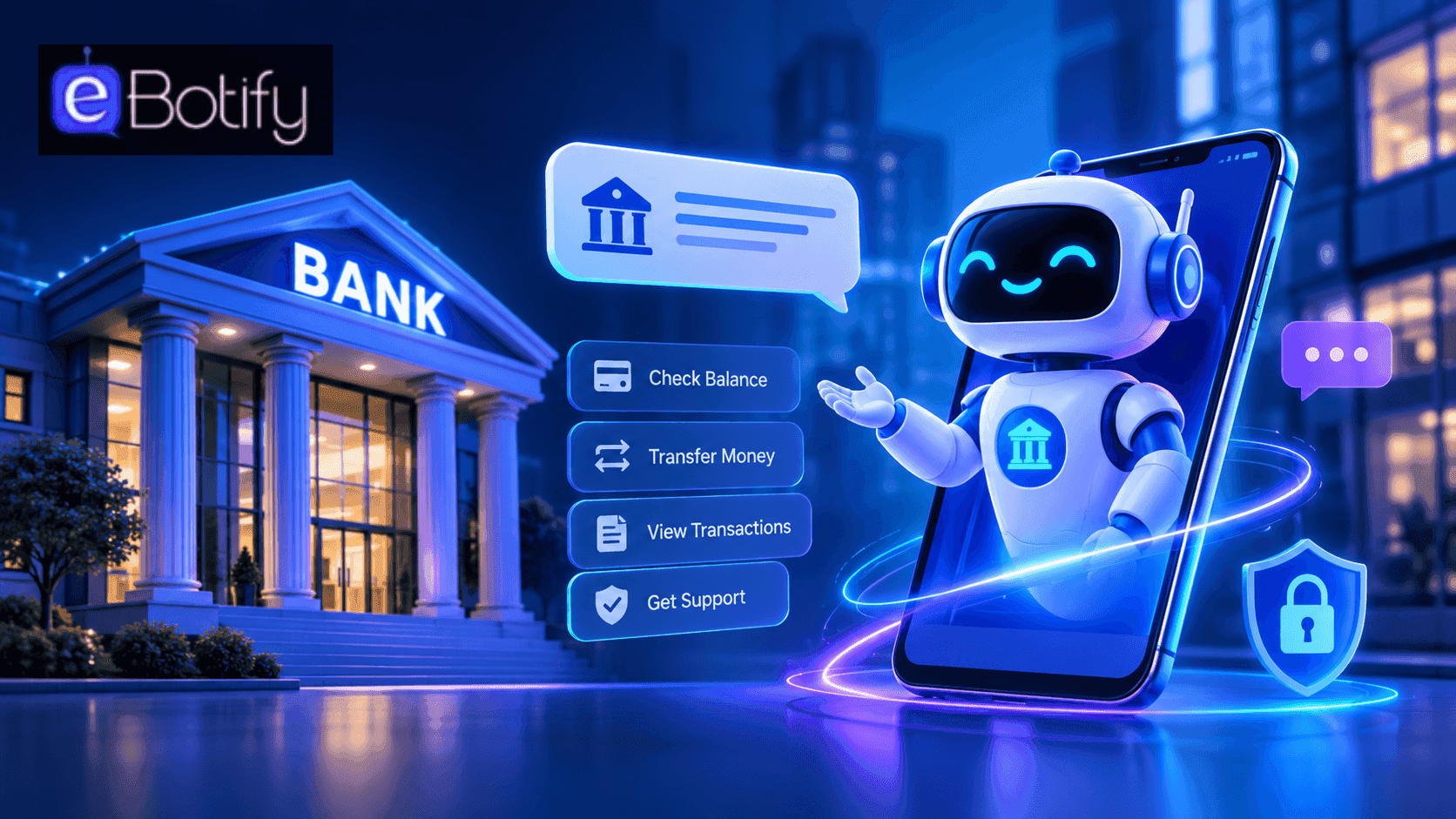
Banks use conversational AI across customer service, account management, and routine financial operations. These applications help customers access information, complete service requests, and receive timely assistance without depending entirely on human support teams.
1. 24/7 Customer Support
Chatbots handle common inquiries about account balances, branch locations, banking hours, and available services. They provide instant responses beyond regular banking hours, allowing customers to access essential information whenever they need assistance.
2. Account and Transaction Assistance
Customers can use chatbots to review recent transactions, request account statements, and understand account activity. Through secure integrations with banking systems, these tools retrieve relevant information and help customers resolve routine account-related queries.
3. KYC and Digital Customer Onboarding
A kyc chatbot guides new customers through identity verification, document submission, and onboarding procedures. It can explain documentation requirements, track application progress, and notify users about missing information. This simplifies the onboarding process while helping banking teams manage verification workflows more efficiently.
4. Fraud Detection and Security Alerts
Chatbots can notify customers about suspicious transactions and provide instructions for reporting unfamiliar activity. They can also guide customers through card-blocking requests and security procedures. Potential fraud cases can be escalated to banking security teams for further investigation.
5. Payment Assistance and Financial Reminders
Customers receive assistance with payment statuses, upcoming bills, EMI notifications, and payment-related inquiries. Chatbots can also send timely reminders about due dates, helping customers stay informed about their financial obligations and avoid missed payments.
6. Loan and Banking Product Assistance
Chatbots answer questions about loan eligibility criteria, interest rates, credit cards, and account options. Using approved product information, they can guide customers towards relevant offerings and explain application requirements, helping them make informed financial decisions.
Business Benefits of Banking Chatbots
Implementing conversational AI offers banks several operational and customer experience benefits. By automating repetitive interactions and improving access to banking services, these tools help financial institutions manage support demands while using their resources more effectively.
1. Reduced Customer Support Costs
Automating frequently asked questions and routine service requests reduces the workload on customer support teams. Banks can manage higher inquiry volumes without increasing staffing requirements at the same rate, helping control operational expenses.
2. Faster Response and Resolution
Chatbots provide immediate responses to common banking inquiries, reducing customer waiting times. Customers can access account information, payment updates, and service guidance without waiting for an available support representative.
3. Improved Customer Experience
Consistent assistance, convenient access, and multilingual communication make banking services easier to navigate. AI in banking customer service also helps financial institutions deliver more relevant responses based on customer questions and conversational context.
4. Higher Employee Productivity
By handling repetitive inquiries, chatbots allow banking employees to focus on complex complaints, sensitive transactions, and customer-specific concerns. This improves workload distribution and gives support teams more time to address cases requiring human judgment.
5. Better Customer Insights
Aggregated conversation analytics help banks identify frequently reported issues, recurring service requests, and gaps in existing processes. These insights can inform service improvements, support decisions, and customer engagement strategies while respecting applicable data privacy requirements.
Security, Data Privacy and Regulatory Compliance
Security and regulatory compliance are essential when deploying conversational AI in financial services. Banks must protect sensitive customer information, maintain secure access to financial systems, and ensure automated interactions follow applicable regulatory requirements.
1. Banking Regulations and Compliance Requirements
- KYC and AML: Banks must follow Know Your Customer (KYC) and Anti-Money Laundering (AML) requirements to verify customer identities, conduct due diligence, and identify suspicious financial activities.
- GDPR and Data Protection: Financial institutions operating under GDPR must establish lawful grounds for processing personal data, obtain consent where required, minimize data collection, and respect customer privacy rights.
- PSD2 and Strong Customer Authentication: Applicable European payment services must follow authentication requirements to protect electronic payment transactions and customer accounts.
- RBI Guidelines: Indian banks must follow applicable RBI directions covering digital payment security, customer data protection, authentication, and secure banking operations.
Regulatory obligations vary depending on the bank's location, services, and applicable financial regulations.
2. Essential Security Measures
Banking chatbots require multiple security controls to protect customer information and connected systems. Important measures include:
Encryption: Protect data during transmission and storage.
Multi-Factor Authentication: Add verification steps before granting access to sensitive services.
Tokenization: Replace sensitive financial details with secure tokens to limit direct data exposure.
Secure API Integrations: Restrict system access through authenticated connections, role-based permissions, and detailed audit logs.
3. Human Oversight and Responsible AI
Banks should establish clear boundaries around automated actions, particularly those involving payments, account changes, and sensitive financial information. Unusual requests and potentially fraudulent activities should be escalated to authorized employees. Regular testing for inaccurate responses, algorithmic bias, and security vulnerabilities is equally important. Customers should also know when they are interacting with AI and have a clear option to reach human support.
Best Practices for Implementing Banking Chatbots
Successful chatbot implementation requires careful planning, secure integrations, and continuous performance monitoring. Banks should consider the following practices:
1. Start With Defined Use Cases
Prioritize frequent, low-risk customer inquiries before introducing automation for sensitive banking operations.
2. Integrate Securely
Connect the chatbot with approved banking platforms through authenticated APIs and appropriate access controls.
3. Establish Escalation Rules
Define when conversations require additional verification or intervention from authorized banking employees.
4. Monitor Performance
Track resolution rates, customer satisfaction, escalation frequency, and security incidents to identify areas for improvement.
For a fintech chatbot, regular testing and updates also help maintain response accuracy, system reliability, and alignment with changing customer expectations and regulatory requirements.
Building More Secure and Responsive Banking Experiences
Conversational AI is helping banks improve customer accessibility, streamline routine operations, and deliver faster support. However, successful implementation requires strong security measures, regulatory compliance, and human oversight to maintain customer trust and protect sensitive financial information.
At eBotify, we develop custom AI-powered chatbots that automate customer interactions, handle routine inquiries, and integrate with business systems. Partner with eBotify to build secure, intelligent chatbot experiences for your banking and financial services.